|
 |
 |
 |
 |
 |
 |
 |
 |

 |
New Method For Making Improved Radiation Detectors
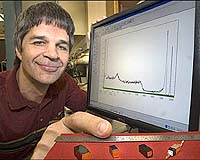
Upton NY (SPX) Jun 05, 2007 Scientists at the U.S. Department of Energy's Brookhaven National Laboratory, with funding from DOE's National Nuclear Security Administration*, have devised ways to improve the performance of radiation detectors, such as those used by law enforcement agencies to locate and identify radioactive material. The improved sensors, for which the Laboratory has filed a U.S. provisional patent application, can be used at room temperature, which makes them more practical and cost-effective than existing detectors with similar performance, which must be operated at very cold temperatures using expensive liquid nitrogen. They can also more accurately detect the X-rays and gamma rays emitted by radiological sources such as dirty bombs and other illicit materials. "Improving the performance of radiation detectors could improve the efficiency and accuracy of cargo screening at U.S. ports," said Brookhaven physicist Aleksey Bolotnikov, one of the inventors. Radiation detectors work by detecting electrons and "holes" - vacancies left by liberated electrons - when ionizing radiation or high-energy particles strike the detector crystal. When the free electrons and holes flow toward electrodes (an anode and a cathode) at either end of the detector, they generate a signal that can be measured and recorded. In an ideal detector, all of the electrons and holes created by the ionization process would arrive at the electrodes. But in reality, holes travel a very short distance before getting trapped by defects in the crystal. Also, because the electrostatic field inside the detector causes some of the electrons to drift, not all of them arrive at the anode. These losses lead to a subsequent inaccuracy in radiation measurements. The Brookhaven-designed sensors improve on this situation by combining methods to shield the detector and focus the electrons toward the anode. In addition, the electrodes at each end of the detector give information about how many electrons/holes get trapped. This "correction factor" can then be used to reconstruct the number of electrons/holes originally created by incident gamma rays or high-energy particles. "Together, these techniques enhance the energy resolution and efficiency of these detectors. In practical terms it means that the improved devices will be able to detect more minute quantities of radiation, detect radioactive materials more quickly or from greater distances, better identify the source of the radiation, and distinguish illicit sources of concern from common naturally occurring radioactive materials," Bolotnikov said. The patent application covers the improved high-energy detectors, as well as methods for making and using them. Details of the electrode design and processing methods are also included. Email This Article
Related Links  Washington (UPI) May 23, 2007
A coalition of Canadian and U.S. businesses, together with local officials and lawmakers from both sides of the border, is scrambling to fix what it says is a policy "train wreck" -- the looming deadline for implementation of tight new regulations on what ID is needed to cross the osmotic northern border of the United States. |
|
|

| The content herein, unless otherwise known to be public domain, are Copyright 1995-2006 - SpaceDaily.AFP and UPI Wire Stories are copyright Agence France-Presse and United Press International. ESA PortalReports are copyright European Space Agency. All NASA sourced material is public domain. Additionalcopyrights may apply in whole or part to other bona fide parties. Advertising does not imply endorsement,agreement or approval of any opinions, statements or information provided by SpaceDaily on any Web page published or hosted by SpaceDaily. Privacy Statement |