|
 |
 |
 |
 |
 |
 |
 |
 |

 |
New Method Determining Age Of Neolithic Artifacts
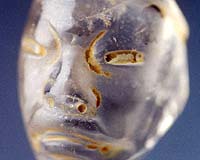
Irvine CA - Apr 13, 2004 A UC Irvine archaeological scientist has created a new method for determining the approximate age of many artifacts between 50,000 to 100,000 years old � a period for which other dating methods are less effective. In a recent study in the Journal of Archaeological Science, Jonathon Ericson, professor and chair of UCI's Environmental Health, Science and Policy Department, and colleagues introduce a new mineral dating technique called quartz hydration dating. The technique dates artifacts containing quartz, a common mineral found in almost every type of rock. Quartz hydration dating is based on a natural phenomenon that occurs when a piece of quartz is fractured. When a statue or a common chopping tool or hand ax is made, the surface is chipped, flaked, fractured or polished. Over time, water diffuses into the freshly exposed surface forming a hydration layer. The thickness of this layer can then be measured by a nitrogen particle beam to determine how many years ago the object was made or fractured naturally. According to Ericson, quartz hydration can date objects that are between 100 and 1 million years old to within 20 to 35 percent of the object's age. Quartz can be found at archaeological excavation sites worldwide from Africa's Olduvai Gorge to China's Choukoutien and even California's Mohave Desert. A ubiquitous mineral, quartz was used in toolmaking from the beginning of human history and also can be found in statues, bowls and ceramics. The new method, however, is particularly useful for dating quartz-containing artifacts in the "chronological gap" that exists for objects that are between 50,000 to 100,000 years old. Other dating methods are poor performers for this period or have questionable accuracy, and the most familiar dating methods are not effective at all. Radiocarbon dating is good for dating organic material up to around 50,000 years old, and potassium argon dating is good for dating mineral samples that are between 100,000 and 4.3 billion years old. Forged artifacts also can be tested with the quartz hydration dating technique. With replications of statues for example, the thinness or lack of the hydration layer will give away their age. The technique may also have applications for dating geological events, such as an earthquake rupture, which would cause natural fracturing of quartz. "What is so exciting about quartz hydration dating is that it opens up the possibilities of dating other minerals, which could lead to a whole new class of materials and processes that could be dated," Ericson said. Ericson's colleagues in the study are Oliver Dersch and Friedel Rauch of the Institute for Nuclear Physics at the Johann Wolfgang Goethe University in Frankfurt, Germany. Partial funding for this study was provided by the National Science Foundation. Community Email This Article Comment On This Article Related Links University of California, Irvine SpaceDaily Search SpaceDaily Subscribe To SpaceDaily Express Dirt, rocks and all the stuff we stand on firmly
 Magnetic Reconnection Region Larger Than 2.5 Million Km Found In The Solar Wind
 Paris (ESA) Jan 12, 2006
Using the ESA Cluster spacecraft and the NASA Wind and ACE satellites, a team of American and European scientists have discovered the largest jets of particles created between the Earth and the Sun by magnetic reconnection. This result makes the cover of this week's issue of Nature. |
|
|

| The content herein, unless otherwise known to be public domain, are Copyright 1995-2006 - SpaceDaily.AFP and UPI Wire Stories are copyright Agence France-Presse and United Press International. ESA PortalReports are copyright European Space Agency. All NASA sourced material is public domain. Additionalcopyrights may apply in whole or part to other bona fide parties. Advertising does not imply endorsement,agreement or approval of any opinions, statements or information provided by SpaceDaily on any Web page published or hosted by SpaceDaily. Privacy Statement |