|
 |
 |
 |
 |
 |
 |
 |
 |

 |
New Methane Chambers To Help Reduce Global Warming
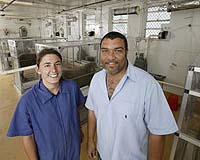
Australia (SPX) Feb 01, 2005 Research to reduce sheeps' production of methane - one of the most potent greenhouse gases - received a boost recently with the installation of four new methane chambers at CSIRO Livestock Industries'facilities in Perth. Shaped like cubicles, the see-through chambers enable researchers to accurately measure the continuous volume of methane produced by sheep over a 24-hour period. They have been operating efficiently for more than four months in a trial to measure the response of sheep to products designed to reduce methane gas emissions. Anti-methanogen project leader, Dr Andre-Denis Wright, says the new chambers are a significant improvement on the previous method of measuring sheep emissions - tanks attached to the animal's backs - and will complement the cattle respiration chambers at the CSIRO's facilities in Rockhampton, Queensland. "The chambers have an open-air system that allows uninterrupted, real-time measurements, making it considerably more accurate and more time and cost efficient," Dr Wright says. "The sheep can also see each other and the researchers while in the cubicles, making them less stressed, so they behave naturally and their feed consumption is not affected." Designed and developed by CSIRO Livestock Industries, the new chambers will be available for use for other research projects both within and outside CSIRO. "Given that livestock account for 12 per cent of Australia's man-made greenhouse gases, it is important that we develop strategies to mitigate methane emissions," Dr Wright says. "CSIRO will be addressing this via other projects to examine plant and feed additives, as well as strategies to manipulate methane-producing microbes in the guts of livestock animals." Community Email This Article Comment On This Article Related Links CSIRO
SpaceDaily
 The Forgotten Methane Source
 Heidelberg, Germany (SPX) Jan 11, 2006
In the last few years, more and more research has focused on the biosphere; particularly, on how gases which influence the climate are exchanged between the biosphere and atmosphere. Researchers from the Max Planck Institute for Nuclear Physics have now carefully analysed which organic gases are emitted from plants. |
|
|

| The content herein, unless otherwise known to be public domain, are Copyright 1995-2006 - SpaceDaily.AFP and UPI Wire Stories are copyright Agence France-Presse and United Press International. ESA PortalReports are copyright European Space Agency. All NASA sourced material is public domain. Additionalcopyrights may apply in whole or part to other bona fide parties. Advertising does not imply endorsement,agreement or approval of any opinions, statements or information provided by SpaceDaily on any Web page published or hosted by SpaceDaily. Privacy Statement |