|
 |
 |
 |
 |
 |
 |
 |
 |

 |
New Material That Contracts Gives Up Secrets To Physicists
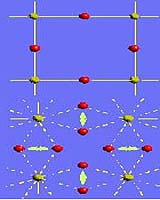
Santa Cruz CA (SPX) Nov 19, 2004 Most solids expand when heated, a familiar phenomenon with many practical implications. Among the rare exceptions to this rule, the compound zirconium tungstate stands out by virtue of the enormous temperature range over which it exhibits so-called "negative thermal expansion," contracting as it heats up and expanding as it cools, and because it does so uniformly in all directions. While engineers are already pursuing practical applications in areas ranging from electronics to dentistry, physicists have had a hard time explaining exactly what causes zirconium tungstate to behave in such a bizarre manner. Now, a team of researchers at the University of California, Santa Cruz, and other institutions has reported new insights into the atomic interactions underlying this phenomenon. A paper describing their findings will be posted online on November 22 and will appear in the December 26 issue of the journal Physical Review Letters. "We have shown that a combination of geometrical frustration and unusual atomic motions are likely to be important to the negative thermal expansion in zirconium tungstate," said Zack Schlesinger, a professor of physics at UCSC. Geometrical frustration sounds like something a high-school math student might feel, but is actually a rich area of research in physics and material science. In simple terms, geometrical frustration is like trying to tile a floor with pentagons - the shapes just won't fit together. In the case of zirconium tungstate, geometrical frustration comes into play during certain temperature-related vibrations of the compound's crystal lattice structure, the configuration of atomic bonds that holds the atoms together in a crystal. The normal thermal expansion of solids results from changes in the atomic motions that make up these lattice vibrations. As heating adds more kinetic energy to the system, the lattice structure expands (in most solids) to accommodate the increasingly energetic atomic motions. To study the atomic motions involved in lattice vibrations, physicists separate the vibrations into discrete "modes" or types of vibrations. In their investigation of zirconium tungstate, Schlesinger and his collaborators found evidence for a rotational ("twisting") mode that, due to geometrical frustration, occurs together with a translational ("back-and-forth") mode. This mixing of rotational and translational motion has the effect of pulling the overall structure together as heating puts more energy into the vibrations. In other materials that show negative thermal expansion, the vibrational modes that pull the solid together create instabilities that eventually lead to rearrangements in the atomic structure. As a result, the negative thermal expansion only occurs over a narrow temperature range. In zirconium tungstate, however, geometrical frustration appears to block any such instability. At least, that is the researchers' current thinking, Schlesinger said. "To understand a complex system like this is not trivial. You have to break it down into all the different components of the atomic motions, and our work is making progress in that direction," he said. "It involves both mathematical analysis and experimental measurements, and ultimately you need to be able to visualize it." The experiments themselves are relatively simple, he said. They involve shining infrared light on a sample of zirconium tungstate and measuring the reflectivity, which can be transformed mathematically into optical conductivity. These measurements reveal the frequencies of light that are absorbed by coupling with the lattice vibrations, and the researchers studied how these measurements changed with temperature. Schlesinger said he initially gave the project to an undergraduate working in his lab, Chandra Turpen. When she began finding anomalous results, graduate student Jason Hancock used mathematical modeling to help figure out what the results meant. "It started out as a senior thesis project that just became a lot more interesting as we went along," Schlesinger said. In addition to Schlesinger, Turpen, and Hancock, who is the first author of the paper, the other coauthors are Glen Kowach of the City College of New York and Arthur Ramirez of Bell Laboratories, Lucent Technologies, in New Jersey. Schlesinger said the findings are interesting with respect to both pure physics and practical applications. On the pure physics side, they seem to provide a new and unusual example of geometrical frustration, which is most often studied in the realm of magnetism and disordered systems such as spin glasses. "This material is not disordered--it is a perfect stoichiometric crystal - so we are seeing geometrical frustration manifested in a whole new system," Schlesinger said. On the practical side, thermal expansion is a big problem in many different areas. In dentistry, most cracked fillings are the result of uneven expansion and contraction - the so-called "tea-to-ice-cream problem." And engineers working on everything from electronics to high-performance engines must cope with the effects of thermal expansion. A material that did not expand or contract with changing temperatures would have broad applications. "If you could create the right mix of materials to neutralize thermal expansion, that would be quite a significant technological advance," Schlesinger said. Community Email This Article Comment On This Article Related Links University of California - Santa Cruz SpaceDaily Search SpaceDaily Subscribe To SpaceDaily Express Space Technology News - Applications and Research
 NGC Chosen To Proceed With Developing Solid-State Laser Technology For Military Applications
 Redondo Beach CA (SPX) Jan 09, 2006
Northrop Grumman Corporation has been selected to develop "military-grade," solid-state laser technology that is expected to pave the way for the U.S. military to incorporate high-energy laser systems across all services, including ships, manned and unmanned aircraft, and ground vehicles. |
|
|

| The content herein, unless otherwise known to be public domain, are Copyright 1995-2006 - SpaceDaily.AFP and UPI Wire Stories are copyright Agence France-Presse and United Press International. ESA PortalReports are copyright European Space Agency. All NASA sourced material is public domain. Additionalcopyrights may apply in whole or part to other bona fide parties. Advertising does not imply endorsement,agreement or approval of any opinions, statements or information provided by SpaceDaily on any Web page published or hosted by SpaceDaily. Privacy Statement |