|
 |
 |
 |
 |
 |
 |
 |
 |

 |
New Martian Meteorite
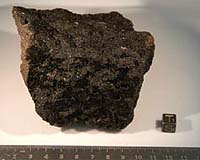
Moffett Field CA (SPX) Jul 21, 2004 While rovers and orbiting spacecraft scour Mars searching for clues to its past, researchers have uncovered another piece of the red planet in the most inhospitable place on Earth -Antarctica. The new specimen was found by a field party from the U.S. Antarctic Search for Meteorites program (ANSMET) on Dec. 15, 2003, on an ice field in the Miller Range of the Transantarctic Mountains, roughly 750 km (466 miles) from the South Pole. This 715.2-gram (1.6-pound) black rock, officially designated MIL 03346, was one of 1358 meteorites collected by ANSMET during the 2003-2004 austral summer. Discovery of this meteorite occurred during the second full field season of a cooperative effort funded by NASA and supported by the National Science Foundation (NSF) to enhance recovery of rare meteorite types in Antarctica, in the hopes new martian samples would be found. Scientists at the Smithsonian Institution's National Museum of Natural History involved in classification of Antarctic finds said the mineralogy, texture and the oxidized nature of the rock are unmistakably martian. The new specimen is the seventh recognized member of a group of martian meteorites called the nakhlites, named after the first known specimen that fell in Nakhla, Egypt, in 1911. Like the other martian meteorites, MIL 03346 is a piece of the red planet that can be studied in detail in the laboratory, providing a critical "reality check" for use in interpreting the wealth of images and data being returned by the spacecraft currently exploring Mars. Following the existing protocols of the U.S. Antarctic meteorite program, scientists from around the world will be invited to request samples of the new specimen for their own detailed research. Nakhlites are significant among the known martian meteorites for several reasons. Thought to have originated within thick lava flows that crystallized on Mars approximately 1.3 billion years ago, and sent to Earth by a meteorite impact about 11 million years ago, the nakhlites are among the older known martian meteorites. As a result they bear witness to significant segments of the volcanic and environmental history of Mars. The U.S. Antarctic Meteorite program is a cooperative effort jointly supported by NSF, NASA and the Smithsonian Institution. Antarctic field work is supported by grants from NASA and NSF to Case Western Reserve University, Cleveland. Initial examination and curation of recovered Antarctic meteorites is supported by NASA at the astromaterials curation facilities at Johnson Space Center in Houston; and initial characterization and long-term curation of Antarctic meteorite samples is supported by NASA and the Smithsonian Institution at the National Museum of Natural History in Washington. Details concerning initial characterization of the specimen and sample availability are available through a special edition of the Antarctic Meteorite Newsletter. Community Email This Article Comment On This Article Related Links SpaceDaily Search SpaceDaily Subscribe To SpaceDaily Express Mars News and Information at MarsDaily.com Lunar Dreams and more
 Spirit Heading To 'Home Plate'
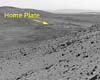 Pasadena CA (JPL) Jan 09, 2006
Last week Spirit completed robotic-arm work on "El Dorado." The rover used all three of its spectrometers plus the microscopic imager for readings over the New Year's weekend. |
|
|

| The content herein, unless otherwise known to be public domain, are Copyright 1995-2006 - SpaceDaily.AFP and UPI Wire Stories are copyright Agence France-Presse and United Press International. ESA PortalReports are copyright European Space Agency. All NASA sourced material is public domain. Additionalcopyrights may apply in whole or part to other bona fide parties. Advertising does not imply endorsement,agreement or approval of any opinions, statements or information provided by SpaceDaily on any Web page published or hosted by SpaceDaily. Privacy Statement |