|
 |
 |
 |
 |
 |
 |
 |
 |

 |
New Lakes Discovered On Titan
Paris, France (SPX) Oct 15, 2007 Newly assembled radar images from Cassini provide the best views of the hydrocarbon lakes and seas on Saturn's moon Titan. A new radar image reveals that Titan's south polar region also has lakes. The southern region images were beamed back after a flyby on 2 October in which a prime goal was the hunt for lakes at the south pole. A new mosaic image comprised from seven Titan fly-bys over the last year and a half shows a north pole pitted with giant lakes and seas, at least one of them larger than Lake Superior in the USA. Approximately 60% of Titan's north polar region, above 60 north, has been mapped by Cassini's radar instrument. About 14% of the mapped region is covered by what scientists interpret as liquid hydrocarbon lakes. "This is our version of mapping Alaska, the northern parts of Canada, Greenland, Scandinavia and Northern Russia," said Rosaly Lopes, Cassini radar scientist at the Jet Propulsion Laboratory, USA. "It is like mapping these regions of Earth for the first time." Lakes and seas are very common at the high northern latitudes of Titan, which is in winter now. Scientists say it rains methane and ethane there, filling the lakes and seas. These liquids also carve meandering rivers and channels on the moon's surface. Now Cassini is moving into unknown territory, down to the south pole of Titan. "We wanted to see if there are more lakes present there and, sure enough, there they are, three little lakes smiling back at us. Titan is indeed the land of lakes and seas," said Lopes. "It will be interesting to see the differences between the north and south polar regions." It is summer at Titan's south pole. A season on Titan lasts nearly 7.5 years, one quarter of a Saturn year, which is 29.5 years long. Monitoring seasonal change helps scientists understand the processes at work there. Scientists are making progress in understanding how the lakes may have formed. On Earth, lakes fill low spots or are created when the local topography intersects a groundwater table. Lopes and her colleagues think that the depressions containing the lakes on Titan may have been formed by volcanism or by a type of erosion (called karstic) of the surface, leaving a depression where liquids can accumulate. This type of lake is common on Earth. "The lakes we are observing on Titan appear to be in varying states of fullness, suggesting their involvement in a complex hydrologic system akin to Earth's water cycle. This makes Titan unique among the extra-terrestrial bodies in our solar system," said Alex Hayes, a graduate student who studies Cassini radar data at the California Institute of Technology in the USA. "The lakes we have seen so far vary in size from the smallest observable, approximately 1 square km, to greater than 100 000 square km, which is slightly larger than the great lakes in midwestern USA," Hayes said. "Of the roughly 400 observed lakes, 70% of their area is taken up by large 'seas' greater than 26 000 square km." Future radar flybys will image closer to the southern pole and are expected to show more lakes. Community Email This Article Comment On This Article Related Links Explore The Ring World of Saturn and her moons Jupiter and its Moons The million outer planets of a star called Sol News Flash at Mercury
 Drizzly Mornings On Xanadu
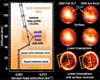 Paris, France (SPX) Oct 12, 2007
Noted for its bizarre hydrocarbon lakes and frozen methane clouds, Saturn's largest moon, Titan, also appears to have widespread drizzles of methane, according to a team of astronomers at the University of California, Berkeley. New near-infrared images from ESO's Very Large Telescope (VLT) in Chile and the W. M. Keck Observatory in Hawaii show for the first time a nearly global cloud cover at high elevations and, dreary as it may seem, a widespread and persistent morning drizzle of methane over the western foothills of Titan's major continent, Xanadu. |
|
|

| The content herein, unless otherwise known to be public domain, are Copyright 1995-2007 - SpaceDaily.AFP and UPI Wire Stories are copyright Agence France-Presse and United Press International. ESA Portal Reports are copyright European Space Agency. All NASA sourced material is public domain. Additional copyrights may apply in whole or part to other bona fide parties. Advertising does not imply endorsement,agreement or approval of any opinions, statements or information provided by SpaceDaily on any Web page published or hosted by SpaceDaily. Privacy Statement |