|
 |
 |
 |
 |
 |
 |
 |
 |

 |
New Horizons Successfully Performs First Post-Launch Maneuvers
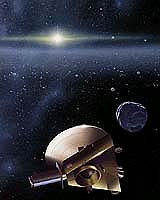
Laurel MD (SPX) Feb 01, 2006 NASA's New Horizons spacecraft has successfully carried out its first post-launch maneuvers, conducting two small thruster firings that slightly adjusted its path toward the outer solar system and the first close-up study of distant planet Pluto. Carried out today and Jan. 28 by mission operators at the Johns Hopkins University Applied Physics Laboratory (APL) in Laurel, Md., the maneuvers refined the spacecraft's trajectory toward a gravity assist-flyby of Jupiter in February 2007. The gravity boost from Jupiter will put New Horizons on course for a close flyby of Pluto and its moons on July 14, 2015. "Everything performed as planned," says New Horizons Project Manager Glen Fountain, of APL. "New Horizons has to fly through a precise aim point near Jupiter to get to Pluto on time and on target, and these maneuvers are putting us on the right path." Conducted with a pair of hydrazine-fueled thrusters on the spacecraft's lower deck, the maneuvers Saturday and today lasted about five and 12 minutes, respectively, providing a total change in velocity of just under 18 meters per second (about 40 miles per hour). The spacecraft was nearly 11.9 million kilometers (7.4 million miles) from Earth when it completed today's maneuver at 2:12 p.m. EST. New Horizons was launched Jan. 19 from Cape Canaveral Air Force Station, Fla., aboard an Atlas V launch vehicle. The powerful Atlas V, combined with a STAR 48 solid-fuel kick motor, sent the piano-sized 1,054-pound probe speeding from Earth at more than 36,000 miles per hour � the fastest spacecraft ever launched. The Atlas V/STAR-48 combination was extremely accurate in placing New Horizons on its outbound trajectory; pre-launch predictions had allowed for a "clean up" maneuver five times the size of the combined thruster firings just completed. "Doing small maneuvers earlier allows us to correct trajectory errors before they grow, which saves more propellant for science observations later in the mission," says Alice Bowman, New Horizons mission operations manager at APL. The mission team plans to conduct one additional, small trajectory correction maneuver this Feb. 15. Close approach to Jupiter will occur on Feb. 28, 2007; besides the gravity assist, the flyby through the Jupiter system will allow the mission team to test the spacecraft's science instruments on the giant planet and its moons. "We're on our way to an exciting Jupiter encounter and a date with destiny at Pluto," says Dr. Alan Stern, New Horizons principal investigator from the Southwest Research Institute in Boulder, Colo. New Horizons is the first mission in NASA's New Frontiers Program of medium-class spacecraft exploration projects. Stern leads the mission and science team as principal investigator. APL manages the mission for NASA's Science Mission Directorate and is operating the spacecraft in flight. The mission team also includes a number of other firms, NASA centers, and university partners. Community Email This Article Comment On This Article Related Links New Horizons at JHUAPL The million outer planets of a star called Sol
 On The Road To Pluto At Last
 Baltimore MD (SPX) Jan 24, 2006
New Horizons is en route to Pluto. I was told at a post-launch party down in Cocoa Beach that our launch came 5 years to the day from the date NASA released the Pluto-Kuiper Belt mission Announcement of Opportunity (AO) that resulted in our selection to build and launch New Horizons. Amazing! |
|
|

| The content herein, unless otherwise known to be public domain, are Copyright 1995-2006 - SpaceDaily.AFP and UPI Wire Stories are copyright Agence France-Presse and United Press International. ESA PortalReports are copyright European Space Agency. All NASA sourced material is public domain. Additionalcopyrights may apply in whole or part to other bona fide parties. Advertising does not imply endorsement,agreement or approval of any opinions, statements or information provided by SpaceDaily on any Web page published or hosted by SpaceDaily. Privacy Statement |