|
 |
 |
 |
 |
 |
 |
 |
 |

 |
New Horizons Passes Another Development Milestone
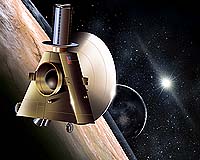
Laurel - Nov 06, 2002 NASA's first mission to Pluto has sailed past another critical milestone, as the New Horizons team successfully completed its second major system-level evaluation. New Horizons held its Preliminary Design Review Oct. 22-24 at The Johns Hopkins University Applied Physics Laboratory (APL) in Laurel, Md., which manages the mission for NASA. A panel of spacecraft and system engineering experts from APL, NASA's Jet Propulsion Laboratory, NASA Goddard Space Flight Center and Southwest Research Institute examined New Horizons' mission plans and spacecraft design - concluding each are reaching their anticipated level of maturity and that the project is ready to proceed. "New Horizons has continued to make substantial progress since its first requirements review five months ago," says Eric Hoffman, the APL Space Department's chief engineer, who chaired the 10-member review panel. "New Horizons has validated its preliminary design and the team can move ahead with more detailed design activities." The New Horizons spacecraft team plans to start construction next year, after additional reviews in the spring. Long lead-time parts are already being ordered. The science instruments underwent design reviews in August and remain on track for completion by summer 2004. "We are on schedule and well within budget," says New Horizons Project Manager Thomas Coughlin, of APL. "We are exactly where we intended to be. This is a great team and we're ready to get on with this mission." New Horizons is working toward a January 2006 launch; it also has backup launch opportunities in February 2006 and February 2007. Depending on the launch vehicle NASA selects - the agency is expected to choose either a Delta IV or an Atlas V by early next year - New Horizons could arrive at Pluto and its moon, Charon, as early as 2015. If launched in January 2006, as planned, it will swing past Jupiter for a gravity boost and scientific studies in 2007. After exploring Pluto-Charon, the spacecraft will encounter up to three other objects in the Kuiper Belt. New Horizons is the first mission to Pluto, its moon, Charon, and the Kuiper Belt of rocky, icy objects beyond. Community Email This Article Comment On This Article Related Links Southwest Research Institute Johns Hopkins University Applied Physics Laboratory Ball Aerospace Jet Propulsion Laboratory SpaceDaily Search SpaceDaily Subscribe To SpaceDaily Express The million outer planets of a star called Sol
 Scientists Show Pluto To Be Colder Than It Should Be
 Cambridge MA (SPX) Jan 5, 2006
Mercury is boiling. Mars is freezing. The Earth is just right. When it comes to the temperatures of the planets, it makes sense that they should get colder the farther away they are from the Sun. But then there is Pluto. It has been suspected that this remote world might be even colder than it should be. Smithsonian scientists now have shown this to be true. |
|
|

| The content herein, unless otherwise known to be public domain, are Copyright 1995-2006 - SpaceDaily.AFP and UPI Wire Stories are copyright Agence France-Presse and United Press International. ESA PortalReports are copyright European Space Agency. All NASA sourced material is public domain. Additionalcopyrights may apply in whole or part to other bona fide parties. Advertising does not imply endorsement,agreement or approval of any opinions, statements or information provided by SpaceDaily on any Web page published or hosted by SpaceDaily. Privacy Statement |