|
 |
 |
 |
 |
 |
 |
 |
 |

 |
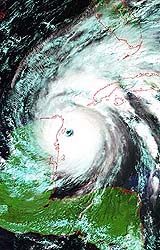
New Forecast Sees Bad Hurricane Season But Milder Than 2005
Paris (AFP) Jun 12, 2006 A long-range forecast issued Thursday became the second prediction in just over a week to declare that this year's Atlantic storm season would be bad, but nowhere as brutal as the 2005 record crop that produced Hurricane Katrina. Tropical Storm Risk (TSR), a London-based group of scientists, said they expected 14 tropical storms for the Atlantic during the season, which runs from June 1 to November 30. Eight of these will be hurricanes and three will be intense hurricanes, it said. Four tropical storms will make landfall on the United States, two of them hurricanes, TSR said. On June 1, University of Colorado climatologists Philip Klotzbach and William Gray forecast 17 tropical storms in the Atlantic, nine of which would become hurricanes. Five of these would be intense hurricanes. These are rated Category Three or higher on the five-point Saffir-Simpson scale. Level three storms on the scale have driving winds of at least 111 miles (178 kilometers) per hour, capable of knocking down large trees and destroying mobile homes. TSR (tropicalstormrisk.com) groups scientists from University College London's Benfield Hazard Research Centre, which is sponsored by the reinsurance industry. TSR has been in operation for four years and has a strong record for accuracy. In a press release, TSR said the data for its 2006 forecast is based on the sea surface temperature and trade wind speed in the Caribbean and tropical North Atlantic, which are the two main drivers for whipping up hurricanes. Lead scientist Mark Saunders said 2003-2005 saw the highest three-year total number of US hurricane landfalls - 11 - since 1900 and the highest three-year total number of North Atlantic hurricanes (31) since reliable records began. Based on current and projected climate signals, there is a 74-percent likelihood that 2006 will be in the top one-third of years for highest storm activity, said Saunders. "Despite this forecast, the chance of 2006 seeing hurricane activity as high as in 2005, which was the most active and destructive season on record, is low," he added. "The current forecast is 20 percent lower than at this time last year. In particular, we expect the Gulf of Mexico to witness far fewer intense hurricanes than in 2005." The biggest storm of last year's season was Hurricane Katrina, a category-three event which killed 1,300 people in the southern United States and left around 100,000 displaced. In all, 2005 saw a record 15 hurricanes among an unprecedented 28 named storms that formed in the Atlantic. For the first time on record, seven of the hurricanes were considered major, meaning they hit category three or higher. It was also the costliest hurricane season, with damage estimated at more than 100 billion dollars.
Source: Agence France-Presse Community Email This Article Comment On This Article Related Links Read more about Disaster Management systems Bringing Order To A World Of Disasters When the Earth Quakes A world of storm and tempest
 Merapi Spews Lava As Authorities Remain On Alert
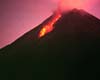 Mount Merapi, Indonesia (AFP) Jun 12, 2006
Indonesia's Mount Merapi continued to spew lava and searing clouds of gas and ash Sunday as geologists maintained the top danger alert on the smoldering volcano. Despite losing Friday a huge chunk of the lava dome forming at its peak which lessened the danger of a major eruption, geologists said the volcano - whose name means "Mountain of Fire" - still posed a threat. |
|
|

| The content herein, unless otherwise known to be public domain, are Copyright 1995-2006 - SpaceDaily.AFP and UPI Wire Stories are copyright Agence France-Presse and United Press International. ESA PortalReports are copyright European Space Agency. All NASA sourced material is public domain. Additionalcopyrights may apply in whole or part to other bona fide parties. Advertising does not imply endorsement,agreement or approval of any opinions, statements or information provided by SpaceDaily on any Web page published or hosted by SpaceDaily. Privacy Statement |