|
 |
 |
 |
 |
 |
 |
 |
 |

 |
New Evidence Supports Terrestrial Cause Of End-Permian Mass Extinction
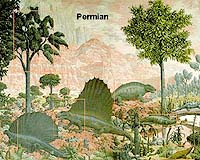
Boulder CO (SPX) Dec 01, 2004 Two hundred and fifty million years ago, ninety percent of marine species disappeared and life on land suffered greatly during the world's largest mass extinction. The cause of this great dying has baffled scientists for decades, and recent speculations invoke asteroid impacts as a kill mechanism. Yet a new study published in the December issue of Geology provides strong indications that the extinction cause did not come from the heavens but from Earth itself. An international team of scientists led by Christian Koeberl from the University of Vienna studied rock samples taken from deep in the Carnic Alps of southern Austria and the western Dolomites in northeast Italy. Their findings promise to fuel what is already one of the hottest debates in earth science. "Our geochemical analyses of these two famous end-Permian sections in Austria and Italy reveal no tangible evidence of extraterrestrial impact," said Koeberl. "This suggests the mass extinction must have been home-grown." Layers of rocks contain a chemical testimony of environmental change though time. Asteroids and comets are chemically different from the Earth and when these objects arrive they leave a tell-tale chemical fingerprint in the rocks. With the help of colleagues from the USA and UK, Koeberl confirmed the presence of the element iridium in the samples. Iridium is abundant in asteroids, comets, and other extraterrestrial material. However, the amounts found were very small compared to those associated with the asteroid impact that many scientists believe killed off the dinosaurs 65 million years ago. At the same time, the team found no traces of the extraterrestrial isotopes helium-3 and osmium-187, commonly associated with impact events. What the team did find, however, was evidence of purely terrestrial processes at work. According to Koeberl, "The slight concentrations of iridium may have been deposited by sluggish oceans when atmospheric carbon dioxide levels were high and seawater oxygen levels were low. The source of the carbon dioxide was probably volcanic activity." Large areas of Earth's crust can be split by volcanic activity to create space in which oceans form. When it comes to cracking continents, however, breaking up is very hard to do. At the close of the Permian, one such failed attempt at ocean forming led to massive volcanic activity in the heart of present day Siberia. Emissions flooded the atmosphere leading to changes in climate and patterns of oceanic circulation. "Our findings support the view that evidence for an extraterrestrial impact event during this time period is weak and inconsistent," said Koeberl. "At the same time, they suggest that widespread volcanic activity may have been the 'smoking gun,' quite literally, that wiped out much of life on Earth." "Geochemistry of the end-Permian extinction event in Austria and Italy: No evidence for an extraterrestrial component," GEOLOGY, December 2004, v. 32, no. 12, p. 1053-1056. Community Email This Article Comment On This Article Related Links Geological Society of America SpaceDaily Search SpaceDaily Subscribe To SpaceDaily Express Explore The Early Earth at TerraDaily.com
 Evolving Away From Extinction
 Berkeley CA (SPX) Jun 27, 2005
The fossilized skeleton of a small crocodile relative excavated last year at Petrified Forest National Park in Arizona throws a wrench into theories of how and where the dinosaurs arose more than 210 million years ago at the end of the Triassic Period. |
|
|

| The content herein, unless otherwise known to be public domain, are Copyright 1995-2006 - SpaceDaily.AFP and UPI Wire Stories are copyright Agence France-Presse and United Press International. ESA PortalReports are copyright European Space Agency. All NASA sourced material is public domain. Additionalcopyrights may apply in whole or part to other bona fide parties. Advertising does not imply endorsement,agreement or approval of any opinions, statements or information provided by SpaceDaily on any Web page published or hosted by SpaceDaily. Privacy Statement |