
 |
 |
 |
 |
 |
 |
 |
 |
 |

 |
New Efficiency Benchmark For Dye-Sensitized Solar Cells
Lausanne, France (SPX) Jun 30, 2008 In a paper published online in the journal Nature Materials, EPFL professor Michael Graetzel, Shaik Zakeeruddin and colleagues from the Changchun Institute of Applied Chemistry at the Chinese Academy of Sciences have achieved a record light conversion efficiency of 8.2% in solvent-free dye-sensitized solar cells. This breakthrough in efficiency without the use of volatile organic solvents will make it possible to pursue large scale, outdoor practical application of lightweight, inexpensive, flexible dye-sensitized solar films that are stable over long periods of light and heat exposure. Dye-sensitized solar cell technology, invented by Michael Gr�tzel at EPFL in the 1990s, shows great promise as a cheap alternative to expensive silicon solar cells. Dye-sensitized cells imitate the way that plants and certain algae convert sunlight into energy. The cells are made up of a porous film of tiny (nanometer sized) white pigment particles made out of titanium dioxide. The latter are covered with a layer of dye which is in contact with an electrolyte solution. When solar radiation hits the dye it injects a negative charge in the pigment nanoparticle and a positive charge into the electrolyte resulting in the conversion of sunlight into electrical energy. The cells are inexpensive, easy to produce and can withstand long exposure to light and heat compared with traditional silicon-based solar cells. Currently, state-of-the-art dye-sensitized cells have an overall light conversion efficiency greater than 11%, still about two times lower than silicon cell technology. A major drawback to the dye-sensitized cell technology is the electrolyte solution, which is made up of volatile organic solvents and must be carefully sealed. This, along with the fact that the solvents permeate plastics, has precluded large-scale outdoor application and integration into flexible structures. To overcome these limitations, Gr�tzel and his colleagues developed a new concept -- a mixture of three solid salts as an alternative to using organic solvents as an electrolyte solution. When the three solid components are mixed together in the right proportion they turn into a melt showing excellent stability and efficiency. Gr�tzel is confident that further development of these types of electrolyte mixtures will lead to large-scale practical application of dye-sensitized solar cell technology, reinforcing solar energy's role as a cornerstone of alternative energy production. Community Email This Article Comment On This Article Share This Article With Planet Earth
Related Links Ecole Polytechnique Federale de Lausanne All About Solar Energy at SolarDaily.com
 Engineering students create solar car
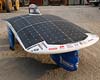 Evanston, Ill. (UPI) Jun 27, 2008
 A solar car created by engineering students is being road-tested in preparation for this summer's North American Solar Challenge. |
|
|

| The content herein, unless otherwise known to be public domain, are Copyright 1995-2007 - SpaceDaily.AFP and UPI Wire Stories are copyright Agence France-Presse and United Press International. ESA Portal Reports are copyright European Space Agency. All NASA sourced material is public domain. Additional copyrights may apply in whole or part to other bona fide parties. Advertising does not imply endorsement,agreement or approval of any opinions, statements or information provided by SpaceDaily on any Web page published or hosted by SpaceDaily. Privacy Statement |
 del.icio.us
 Digg
Digg Reddit
 YahooMyWeb
 Google
 Facebook