
 |
 |
 |
 |
 |
 |
 |
 |
 |

 |
New Discovery Could Enable Development Of Faster Computers
Riverside CA (SPX) Jul 01, 2008 Physicists at UC Riverside have made an accidental discovery in the lab that has potential to change how information in computers can be transported or stored. Dependent on the "spin" of electrons, a property electrons possess that makes them behave like tiny magnets, the discovery could help in the development of spin-based semiconductor technology such as ultrahigh-speed computers. The researchers were experimenting with ferromagnet/semiconductor (FM/SC) structures, which are key building blocks for semiconductor spintronic devices (microelectronic devices that perform logic operations using the spin of electrons). The FM/SC structure is sandwich-like in appearance, with the ferromagnet and semiconductor serving as microscopically thin slices between which lies a thinner still insulator made of a few atomic layers of magnesium oxide (MgO). The researchers found that by simply altering the thickness of the MgO interface they were able to control which kinds of electrons, identified by spin, traveled from the semiconductor, through the interface, to the ferromagnet. Experimental results: - The spin of an electron is represented by a vector, pointing up for an Earth-like west-to-east spin; and down for an east-to-west spin. - In the researchers' experiment with the FM/SC structures, both spin up and spin down electrons were allowed to travel from the semiconductor to the ferromagnet. - The researchers found that when the structure's MgO interface is very thin (less than two atomic layers), spin down electrons pass through to the ferromagnet, while spin up electrons are reflected back, leaving only spin up electrons in the semiconductor. - They also found that when the interface is thicker than six atomic layers, both spin up and spin down electrons are reflected back, leaving electrons with zero net spin in the semiconductor. But the surprising result for the researchers was that at an intermediate thickness, ranging from two to six atomic layers, the selectivity of the interface completely changes. "We see a dramatic and complete reversal in the spin of electrons that pass through the interface," said Roland Kawakami, an assistant professor of physics who led the research team. "This time, spin up electrons pass through while spin down electrons are reflected back to the semiconductor. In other words, the thickness of the MgO interface determines whether spin up or spin down electrons are allowed to pass through it." According to his research team, such a "spin reversal" can be used to control current flow. Significance of the discovery: "Electron spins are oriented at random in an ordinary electric circuit, and, therefore, do not affect current flow," explained Yan Li, the first author of the research paper, who made the discovery. "But if spin is polarized, that is, aligned in one direction, you can manipulate the flow of current and the transport of information - a feature that would be of great interest to the semiconductor industry. What is amazing is that only a couple of atomic layers of MgO can completely reverse the spin selection of the interface. This is unexpected because MgO is not a magnetic material." Li, a graduate student in the Department of Physics and Astronomy working toward her doctorate in physics, said the research team will work next on making electronic devices based on the spin reversal. "This will not only test its feasibility for applications, but also help determine the cause of the spin reversal, which is still unclear," she said. Kawakami's lab is one of very few labs in the world that perform both the advanced material synthesis and pulsed laser measurements needed for experiments with FM/SC structures. "Without the strong interplay between the materials development and optical measurements, the type of discovery we made probably would not have been possible," Kawakami said. A new area of research, spintronics already has helped develop disk-drive read heads and non-volatile memory chips. Researchers believe spintronics also will make "instant-on" computers one day, as well as chips that can store and process data. Community Email This Article Comment On This Article Share This Article With Planet Earth
Related Links University of California - Riverside Super Computer News and HPC Technology
 NASA Develops Highest Resolution Visualization System To Date
 Moffett Field CA (SPX) Jun 26, 2008
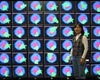
The power to visualize highly complex information in a way that's easier for the human mind to grasp is taking a giant leap forward with the advent of NASA's new hyperwall-2 system unveiled at Ames Research Center. |
|
|

| The content herein, unless otherwise known to be public domain, are Copyright 1995-2007 - SpaceDaily.AFP and UPI Wire Stories are copyright Agence France-Presse and United Press International. ESA Portal Reports are copyright European Space Agency. All NASA sourced material is public domain. Additional copyrights may apply in whole or part to other bona fide parties. Advertising does not imply endorsement,agreement or approval of any opinions, statements or information provided by SpaceDaily on any Web page published or hosted by SpaceDaily. Privacy Statement |

 del.icio.us
 Digg
Digg Reddit
 YahooMyWeb
 Google
 Facebook