
 |
 |
 |
 |
 |
 |
 |
 |
 |

 |
New Developments On The Road To Cosmos 2
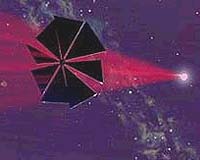
Pasadena CA (SPX) Jun 25, 2008 The Planetary Society and Cosmos Studios remain committed to flying the first flight with light. Our spacecraft, Cosmos 2, is a maneuverable solar sail that may be the precursor to a new mode of interplanetary travel, and could one day take us to the stars. In addition, through our cooperation with other organizations, we are continuing to encourage the development of solar sail technology. Sometime within the next few weeks NASA Ames Research Center plans to launch a "nano-sail" as a piggy-back payload on the Falcon launch vehicle - a private booster designed and built by Planetary Society Board Member Elon Musk's SpaceX corporation. This small sail, developed by NASA's Marshall Space Flight Center (MSFC), would test atmospheric drag on the sail, but will not be making a controlled flight under sunlight pressure, which is the goal of Cosmos 2. The Society has been cooperating with the MSFC solar sail technology program for several years. The Planetary Society also donated 5-micron thick sail material for a similar flight planned by a student group from Poland. The project will test the deployment of a solar sail and the use sail-like structures inside Earth's atmosphere to provide drag for satellite re-entry. The students have built a Cubesat, which they will piggy-back on a launch by the European Space Agency. NASA Marshall Space Flight Center has asked The Planetary Society to study integrating an existing solar sail module into a flight spacecraft, and arrange for its launch. The module was originally built by industry contractors for a Solar Sail technology program that was later cancelled. The Society has begun studying options for using that sail module. This is not all. Thanks to our central position in the field of solar sailing other groups have also approached us with suggestions for smaller-scale flight experiments aimed at advancing solar sail technology. We will study the most promising of these, while at the same pushing ahead with the development of Cosmos 2. We are determined to be the first to fly with light.
What's new with Cosmos 2 Even with partial funding, we have initiated work at IKI, the Russian Space Research Institute, on the long-lead development of hardware for the Cosmos 2 spacecraft. This includes the electronics, solar array, and solar sail motors. We have also started studying possible launch configurations on a reliable launch vehicle. Our preferred option at this point is for Cosmos 2 to piggy-back on a mission that will lift into space on the Russian Soyuz-Fregat booster. Soyuz is the same launcher that takes astronauts, cosmonauts and tourists to the space station, and it has accumulated a remarkable success record over the past several decades. The Lavochkin Company, responsible for the spacecraft-launch interface, believes that several such launch opportunities are available over the next two to three years. In addition to the Soyuz-Fregat's impressive track record, it would also allow for several simplifications in the design of the new solar sailas against Cosmos 1. This is because the interface with between the solar sail and the Soyuz-Fregat launcher would be much less constrained than the interface designed for the submarine-launched Volna. These simplifications may permit a lower weight spacecraft with some innovations, while preserving the basic design and qualification of the Cosmos 2 spacecraft. Community Email This Article Comment On This Article Share This Article With Planet Earth
Related Links The Planetary Society Space Tourism, Space Transport and Space Exploration News
 Applicants From All ESA Member States To Become An European Astronaut
 Cologne, Germany (SPX) Jun 24, 2008
SA began its search for new astronauts on 19 May, calling for applications from talented individuals who wish to join the European Astronaut Corps. Almost 10 000 individuals registered to begin the application process. |
|
|

| The content herein, unless otherwise known to be public domain, are Copyright 1995-2007 - SpaceDaily.AFP and UPI Wire Stories are copyright Agence France-Presse and United Press International. ESA Portal Reports are copyright European Space Agency. All NASA sourced material is public domain. Additional copyrights may apply in whole or part to other bona fide parties. Advertising does not imply endorsement,agreement or approval of any opinions, statements or information provided by SpaceDaily on any Web page published or hosted by SpaceDaily. Privacy Statement |
 del.icio.us
 Digg
Digg Reddit
 YahooMyWeb
 Google
 Facebook