|
 |
 |
 |
 |
 |
 |
 |
 |

 |
New Dawn Or False Dawn? Fusion "Breakthrough" Leaves Some Cold
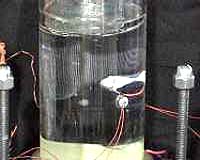
Paris (AFP) Mar 6, 2002 Claims by Russian and US scientists that they may have created nuclear fusion on a lab bench have met with a guarded response from physicists hardened to setbacks in their quest for this tantalising energy source. For decades researchers have been mesmerised by the idea of replacing dirty fossil fuels and dangerous atomic piles with the same energy process that drives the Sun. Nuclear fission, the chain reaction used in power plants and atomic bombs, entails splitting an atom to release energy. Nuclear fusion entails welding two isotopes of hydrogen together at ultra-high temperatures, causing them to form a heavier element in a burst of release energy. As hydrogen is present in water, the world's commonest substance, the source of fuel is potentially unlimited. Pollution would in theory be negligible, nor would there be any perilous waste to guard. Billions of dollars have been lavished on this dream of star power, but the tale so far is a litany of disappointment. Efforts to mimick the Sun's own fusion process in terrestrial laboratories have met with huge technical problems, such as sustaining the process beyond a fraction of a second and controlling the super-heated plasma gas in which atoms are forged together. The cruellest episode was in 1989, when two scientists, Stanley Pons of the University of Utah and Martin Fleischmann of Britain's University of Southampton, announced in a blaze of publicity that they had achieved "cold fusion" in a test tube using palladium. That claim was rubbished after no-one was able to replicate the results. Fusion is now back in the headlines thanks to an experiment with two coffee-cup sized beakers by physicists at Oak Ridge National Laboratory in Tennessee and at the Rensselaer Polytechnic Institute in New York. Reporting in this week's Science, one of the world's most prestigious scientific journals, they said they fired ultrasound at beakers containing chilled liquid acetone, triggering waves of oscillations and powerful vacuums. By firing neutrons into the acetone, they helped to seed the liquid with bubbles that then swiftly expanded before being imploded, with astonishing force, in the high-pressure vacuums caused by the sound wave. According to the researchers' calculations, the collapsing of the bubbles generated temperatures as hot as the Sun for a few trillionths of a second. That heat, they believe, was high enough to form hydrogen isotopes in the acetone to be fused together. Although no actual fusion was observed, the scientists say they spotted tritium and neutrons that are a typical byproduct of that process. A big question mark remains, though. Two independent scientists tried to replicate the results, but saw no evidence of any fusion. Science published both pieces of research -- the claim (which was submitted to an exhaustive peer assessment) as well as the rebuttal. "Scientists will -- and should -- remain sceptical until the experiments are reproduced by others," University of Michigan physicist Fred Bechetti commented in Science, contending though that the claim was "credible until proven otherwise." Robert Park, a University of Maryland physicist who has written extensively about bad science, disagreed, bluntly saying the episode "presaged a repeat of the cold fusion fiasco 13 years ago." Mathias Fink, director of the acoustics laboratory at Paris' Superior School of Industrial Chemistry and Physics, said he was impressed with the "original... (and) serious" work of the US team, and believed fusion "may have taken place." But, he said, "The job now is to verify the results. Only then can we decide." Opinions concur that if there was indeed a breakthrough, it will take many years to transform the discovery into something useable. "The problem will still be to develop engineering devices that will produce more power from fusion than is needed to sustain the conditions that make the fusion possible," Thornton Greenland, a physicist at University College London, said. Community Email This Article Comment On This Article Related Links SpaceDaily Search SpaceDaily Subscribe To SpaceDaily Express Space Technology News - Applications and Research
 Industry Team Achieve New Communications Technology With AESA Radars
 Baltimore MD (SPX) Jan 12, 2006
A team comprised of three leading US aerospace and defense contractors has demonstrated an innovative technological use of active electronically scanned array (AESA) radars for high-bandwidth communications. |
|
|

| The content herein, unless otherwise known to be public domain, are Copyright 1995-2006 - SpaceDaily.AFP and UPI Wire Stories are copyright Agence France-Presse and United Press International. ESA PortalReports are copyright European Space Agency. All NASA sourced material is public domain. Additionalcopyrights may apply in whole or part to other bona fide parties. Advertising does not imply endorsement,agreement or approval of any opinions, statements or information provided by SpaceDaily on any Web page published or hosted by SpaceDaily. Privacy Statement |