
 |
 |
 |
 |
 |
 |
 |
 |
 |

 |
New Danger Emerges In Anti-Submarine Warfare Part One
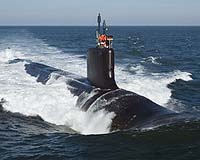
Washington (UPI) Jun 12, 2008 For more than 90 years, the submarine has been the key strategic weapon of war at sea. Britain was nearly starved into submission by German submarines in both world wars, and Japan was effectively isolated, starved and defeated by U.S. submarines in World War II. So why do 21st century Western navies and their political bosses always devote so little time to anti-submarine warfare? ASW was essential to the Allied victories in both world wars. And it was also a life-or-death issue through the long decades of the Cold War. In those years the threat was two-fold: First, Soviet strategic nuclear submarines, or "boomers," armed with submarine-launched ballistic missiles -- SLBMs -- posed the main strategic threat to the United States, just as the strategic subs of the U.S. Navy did in return to the cities of the Soviet Union. But second, the large Soviet submarine fleet, much of it nuclear-powered, posed a far more formidable threat to America's sea communications with its main allies across the Atlantic and Pacific Oceans than the old, low-tech, primitive even by 1940s standards U-boats of the Kriegsmarine ever did during the Battle of the Atlantic. The British and U.S. navies both started World War II woefully complacent and unprepared about the threat that even the relative handful of Nazi submarines was going to represent. The only thing that saved the Allies from losing the war was that Grand Adm. Erich Raeder, the commander in chief of the German navy, was equally unprepared. He lacked the genius, strategic vision and disciplined, relentless focus of Adm. Karl Doenitz, the World War I U-boat veteran commander who commanded the German submarine force at the start of the war. Fortunately for the Allies, Adolf Hitler only replaced Raeder with Doenitz in May 1943, so the Germans concentrated on developing their attack submarines too late to win the war. U.S. and NATO navy commanders and their governments didn't make the same mistake during the Cold War, when ASW and anti-submarine weapons and forces were given serious priority. But in the complacent years following the collapse of communism and the disintegration of the Soviet Union at the end of 1991, the old importance of ASW has been largely forgotten, especially in the U.S. Navy. In the early 1990s the U.S. Navy even shut down its monitoring office to track submarine technology in other nations around the world. Now the threat has re-emerged, but in unexpected ways and places. The great threat today doesn't come only from nuclear submarines armed with SLBMs. They are still a threat, but they are enormously expensive and technologically daunting. China has had repeated problems with both building and operating its own handful of nuclear-powered and nuclear-armed submarines, and even Russia has had a lot of difficulty adapting the Bulava, the sea-launched version of its Topol-M intercontinental ballistic missile, to be launched from the smaller launching tubes of its newer, smaller and therefore less easily detectable fourth-generation Borei 955 class of strategic nuclear submarines. U.S. naval strategists followed these developments closely. They were far slower, however, to recognize that the really serious 21st century submarine threat was going to come from a technology they had abandoned decades earlier as obsolete. Next: The rise of the diesel-electric subs Community Email This Article Comment On This Article Share This Article With Planet Earth
Related Links The latest in Military Technology for the 21st century at SpaceWar.com
 Analysis: Hezbollah's armory up for debate
 Washington (UPI) Jun 12, 2008
 Hezbollah's recent flexing of its muscles in Lebanon may well lead to an unintended effect -- the long-overdue disarming of the militant group. |
|
|

| The content herein, unless otherwise known to be public domain, are Copyright 1995-2007 - SpaceDaily.AFP and UPI Wire Stories are copyright Agence France-Presse and United Press International. ESA Portal Reports are copyright European Space Agency. All NASA sourced material is public domain. Additional copyrights may apply in whole or part to other bona fide parties. Advertising does not imply endorsement,agreement or approval of any opinions, statements or information provided by SpaceDaily on any Web page published or hosted by SpaceDaily. Privacy Statement |
 del.icio.us
 Digg
Digg Reddit
 YahooMyWeb
 Google
 Facebook