|
 |
 |
 |
 |
 |
 |
 |
 |

 |
New Cruise Missile Successful In First Flight Test
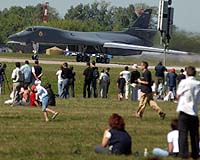
Eglin AFB FL (SPX) Jun 02, 2006 The Air Force's newest cruise missile was successfully launched for the first time May 18. The Joint Air-to-Surface Standoff Missile - Extended Range was released from a B-1B Lancer and cruised more than 400 nautical miles to its target at White Sands Missile Range, N.M. "This was the culmination of a lot of hard work by a lot of people within the Joint Air-to-Surface Standoff Missile - Extended Range team," said U.S. Air Force Lt. Col. Stephen Davis, squadron commander for Joint Air-to-Surface Standoff Missile Block 2. "Everything went as planned and the launch was a total success." The stealthy cruise missile is an autonomous, conventional munition designed to defeat heavily defended, high-priority enemy targets deep behind enemy lines. Although Joint Air-to-Surface Standoff Missile - Extended Range looks the same and provides all the capabilities of the baseline missile, it has a new engine and carries more fuel. Those changes enable it to fly more than 500 nautical miles as compared to original Joint Air-to-Surface Standoff Missile's range of more than 200 nautical miles. "These low-risk modifications were made without disturbing the missile's outer shape and size, thus reducing the cost and development time for the effort," said Mike VandenBoom, chief engineer for the Joint Air-to-Surface Standoff Missile - Extended Range. Like the original Joint Air-to-Surface Standoff Missile, the extended range missile uses its inertial navigation and global positioning systems to find its intended target and then its infrared seeker for pinpoint accuracy right before impact. The Joint Air-to-Surface Standoff Missile - Extended Range can be released in virtually any weather and with its extended range will provide another tool to combatant commanders once in the Air Force inventory. "Joint Air-to-Surface Standoff Missile - Extended Range couples lethal accuracy with extended standoff range, giving the warfighter a reliable and safe option for eliminating critical first strike defenses," said U.S. Air Force Col. John Griggs, commander for 308th Armament Systems Group. The B-1B is Joint Air-to-Surface Standoff Missile - Extended Range's threshold aircraft, but plans are in the works to integrate onto other systems. "Like the baseline version, Joint Air-to-Surface Standoff Missile - Extended Range will be capable of employment from the B-2, B-52, F-15 and F-16," said Buff Tibbetts, test engineer for the Joint Air-to-Surface Standoff Missile - Extended Range. This launch was the first in a series of flight tests that are scheduled to run through December 2008. Community Email This Article Comment On This Article Related Links - Learn about missile defense at SpaceWar.com All about missiles at SpaceWar.com
 Pentagon seeking non-nuclear submarine missile
 New York (AFP) May 29, 2006
 The Pentagon is pressing Congress to approve the development of a new weapon that would enable the United States to carry out non-nuclear missile strikes against distant targets within an hour, The New York Times reported in its Monday edition. |
|
|

| The content herein, unless otherwise known to be public domain, are Copyright 1995-2006 - SpaceDaily.AFP and UPI Wire Stories are copyright Agence France-Presse and United Press International. ESA PortalReports are copyright European Space Agency. All NASA sourced material is public domain. Additionalcopyrights may apply in whole or part to other bona fide parties. Advertising does not imply endorsement,agreement or approval of any opinions, statements or information provided by SpaceDaily on any Web page published or hosted by SpaceDaily. Privacy Statement |