
 |
 |
 |
 |
 |
 |
 |
 |
 |

 |
New Clues To Air Circulation In The Atmosphere
London, UK (SPX) Aug 28, 2008 Air circulates above the Earth in four distinct cells, with two either side of the equator, says new research out in Science. The new observational study describes how air rises and falls in the atmosphere above the Earth's surface, creating the world's weather. This process of atmospheric circulation creates weather patterns and influences the climate of the planet. It is important to understand these processes in order to predict weather events, and to improve and test climate models. Previous theories have claimed that there are just two large circular systems of air in the atmosphere, one either side of the equator. These theories suggested that air rises at the equator and then travels towards either the north or south polar regions, where it falls. The new research suggests instead that there are two cells in both the northern and southern hemispheres. In the first cell, air rises at the equator and then falls in the subtropics. In the second cell, air rises in the mid-latitudes - approximately 30 to 60 degrees north and south of the equator - and then falls in the polar regions. The researchers say that this second cell of rising air is a mechanism responsible for setting the distribution of temperature and winds in the mid-latitudes which has not been fully appreciated before. The mid-latitudes include the UK, Europe and most of the United States. Dr Arnaud Czaja from Imperial College London's Department of Physics and the Grantham Institute for Climate Change, one of the authors of the new research, explains: "Our model suggests that there is a second cell of air in each hemisphere which is characterised by air rising, clouds forming, storms developing and other processes associated with moisture in the air occurring in the mid-latitudes." Current theories to describe weather patterns in the mid-latitudes do not take these moisture-based processes into consideration. Dr Czaja argues that these theories are therefore incomplete, and that water vapour plays as much of an important role in the weather systems of the mid-latitudes as it does in the tropics, where it is a well-documented driver of weather events. The research team carried out their study by conducting new analyses of extensive meteorological data. Dr Czaja says that he hopes the research will lead to a more detailed understanding of how air circulation in our atmosphere works, and how it affects the weather: "With more attention than ever before being focused on understanding our planet's climate, weather systems and atmosphere, it's important that scientists challenge their own assumptions and current theories of how these complex processes work. I think our study sheds new light on the driving forces behind the weather in the mid-latitudes," Dr Czaja added. Community Email This Article Comment On This Article Share This Article With Planet Earth
Related Links Imperial College London The Air We Breathe at TerraDaily.com
 Strange Clouds At The Edge Of Space
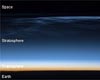 Huntsville AL (SPX) Aug 26, 2008
When in space, keep an eye on the window. You never know what you might see. Last month, astronauts on board the International Space Station (ISS) witnessed a beautiful display of noctilucent or "night-shining" clouds. |
|
|

| The content herein, unless otherwise known to be public domain, are Copyright 1995-2007 - SpaceDaily.AFP and UPI Wire Stories are copyright Agence France-Presse and United Press International. ESA Portal Reports are copyright European Space Agency. All NASA sourced material is public domain. Additional copyrights may apply in whole or part to other bona fide parties. Advertising does not imply endorsement,agreement or approval of any opinions, statements or information provided by SpaceDaily on any Web page published or hosted by SpaceDaily. Privacy Statement |
 del.icio.us
 Digg
Digg Reddit
 YahooMyWeb
 Google
 Facebook