|
 |
 |
 |
 |
 |
 |
 |
 |

 |
New Climate Model Predicts Greater 21st Century Warming
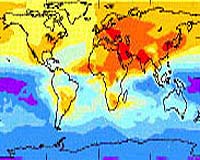
Washington - May 20, 2003 For the first time, scientists have incorporated multiple human and natural factors into a climate projection model. They predict that increased carbon dioxide in the atmosphere, due to changes in the carbon cycle, combined with a decrease in human-produced sulphates, may cause accelerated global warming during the 21st century, as compared with simulations without these feedback effects. Results of the study, completed by Chris D. Jones and colleagues at the Met Office's Hadley Centre for Climate Prediction and Research in Bracknell, United Kingdom, appear in the journal Geophysical Research Letters, published by the American Geophysical Union. Previous studies have indicated that human activities, such as carbon dioxide and sulphate emissions, as well as natural factors, such as changes in solar radiation, emissions from volcanic eruptions and interactions between climate and the carbon cycle, are important mechanisms for causing climate change. No previous climate studies have, however, integrated all of these factors into a single climate experiment. The climate-carbon cycle experiment completed by Jones and his colleagues is the first to take a more comprehensive Earth-systems approach to climate modeling. This "all-forcings experiment," or ALL, incorporates carbon dioxide emissions, non-carbon dioxide greenhouse gases, human-produced sulphate aerosol levels, the reflection of solar radiation associated with sulphate in the atmosphere (the "albedo effect"), atmospheric ozone levels, levels of solar radiation, the effects of volcanic eruptions, and climate-carbon cycle feedbacks. Discrepancies between observed temperature trends in the 20th century and climate simulations that consider only a limited number of factors have hindered the ability of some models to predict future climate change. The ALL model was, however, able to recreate observed temperature records for the 20th century, illustrating the importance of including multiple factors in climate change projections. Also, the rise in carbon dioxide simulated by ALL more closely matches the observed carbon dioxide rise than did previous models. The researchers say that this indicates that mechanisms other than direct carbon dioxide emissions caused by human activity also contribute to the observed trend. Jones and his colleagues were also able to replicate estimates of the amount of carbon currently stored in the oceans and on land worldwide. With regard to future climate predictions, ALL shows that predicted reductions in human sulphate emissions will cause a reduction in the cooling effect associated with sulphates in the atmosphere, or a net warming. The model predicts that the resultant warming will enhance soil respiration, meaning that the increased amounts of carbon stored in the soil during the 20th century will be released into the atmosphere, causing a faster rise in atmospheric carbon dioxide. By the end of the 21st century, the authors state, the increase in carbon dioxide and decrease of sulphates will cause a substantially higher global warming of 5.5 degrees Celsius [9.9 degrees Fahrenheit] compared with 4 degrees Celsius [7 degrees Fahrenheit] when these interactions are neglected. Title of article: "Strong carbon cycle feedbacks in a climate model with interactive CO2 and sulphate aerosols" Citation: Jones, C. D., P. M. Cox, R. L. H. Essery, D. L. Roberts, and M. J. Woodage, Strong carbon cycle feedbacks in a climate model with interactive CO2 and sulphate aerosols, Geophys. Res. Lett., 30(9), 1479, doi:10.1029/2003GL016867, 2003. Community Email This Article Comment On This Article Related Links SpaceDaily Search SpaceDaily Subscribe To SpaceDaily Express Dirt, rocks and all the stuff we stand on firmly
 Magnetic Reconnection Region Larger Than 2.5 Million Km Found In The Solar Wind
 Paris (ESA) Jan 12, 2006
Using the ESA Cluster spacecraft and the NASA Wind and ACE satellites, a team of American and European scientists have discovered the largest jets of particles created between the Earth and the Sun by magnetic reconnection. This result makes the cover of this week's issue of Nature. |
|
|

| The content herein, unless otherwise known to be public domain, are Copyright 1995-2006 - SpaceDaily.AFP and UPI Wire Stories are copyright Agence France-Presse and United Press International. ESA PortalReports are copyright European Space Agency. All NASA sourced material is public domain. Additionalcopyrights may apply in whole or part to other bona fide parties. Advertising does not imply endorsement,agreement or approval of any opinions, statements or information provided by SpaceDaily on any Web page published or hosted by SpaceDaily. Privacy Statement |