|
 |
 |
 |
 |
 |
 |
 |
 |

 |
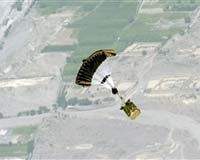
New Airdrop System Offers More Precision From Higher Altitudes
Southwest Asia (SPX) Oct 30, 2006 A new, self-steering airdrop system that's being field tested in Afghanistan represents a revolutionary step beyond traditional delivery methods, the commander of U.S. Central Command Air Forces told a group visiting the command headquarters here during the past weekend. For security reasons, officials requested the base's exact location not be revealed. Air Force Lt. Gen. Gary North praised the new Joint Precision Airdrop System that steers itself from high altitudes using its own global positioning system. "It's FedEx and Domino's, all at once," he told civilian leaders participating in the Joint Civilian Orientation Conference. JPADS offers more accuracy than conventional airdrop methods in delivering supplies to ground troops in extremely remote locations, he said. It also enables drops from higher altitudes, better protecting delivery aircraft from enemy threats. The new system got its first combat tryout in late August when a C-130 Hercules aircraft from the 774th Expeditionary Airlift Squadron dropped supplies to an Army unit operating in a remote location in Afghanistan. Air Force Maj. Neil Richardson, chief of the combat programs and policy branch at Air Mobility Command, gave the performance a thumbs-up. "The system did exactly what it was designed for and delivered ammunition and water to ground troops here in Afghanistan," he said. The Army and Air Force have been developing the JPADS together since the early 1990s. The Army created the airborne guidance unit and parachute decelerators. Meanwhile, the Air Force developed the system's mission planner, a laptop computer that hooks into the cockpit of a C-130 Hercules or C-17 Globemaster III aircraft. This system programs in updated wind data and reference points to the target, as well as new target data based on the ground situation, said Army Lt. Col. Ralph Saunders, Joint Forces Command's operational manager for the system. Here in the theater of operations, Air Force Lt. Col. Charles Ciuzio, chief of the Air Mobility Division at the Combined Air Operations Center, explained during a recent Pentagon videoconference how this capability is supporting the mission. "As the aircraft enters the target area, it releases a probe that transmits real-time wind data back to the aircraft," he said. "The laptop on the plane takes that wind data a computes a 'launch acceptable' region. The crew then flies and releases the bundle within that region." After being released from altitudes as high as 25,000 feet, the pallet drops at speeds topping 100 miles an hour to a secondary release point 1,000 to 1,500 feet above the ground, Ciuzio explained. From that point, the JPAD system releases a larger canopy that delivers the load safely to the ground. Ultimately, officials say they plan to field four sizes of JPADS, the largest of which will be able to airdrop up to 60,000 pounds of cargo -- including a Stryker combat vehicle -- to troops on the ground. They compare the accuracy the system will bring to the airlift community to the capability strike pilots gained with GPS-guided bombs. In the meantime, Ciuzio said, the JPADS is bringing an important new capability to the war on terror. "The ability to accurately airdrop supplies to remote areas, while keeping our aircraft out of the enemy threat, is a significant increase in the capability that we currently have in theater and our ability to support the warfighter," he said. Community Email This Article Comment On This Article Related Links GPS Applications, Technology and Suppliers The latest in Military Technology for the 21st century at SpaceWar.com GPS Applications, Technology and Suppliers
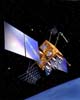
 Second Modernized GPS Satellite Built By LockMart Begins Service
 Denver CO (SPX) Oct 26, 2006
The second modernized Global Positioning System Block IIR (GPS IIR-M) satellite, designed and built by Lockheed Martin has been declared fully operational for military and civilian navigation users around the globe. This milestone is the culmination of a successful on-orbit deployment and check- out phase that allowed the spacecraft to begin service ahead of the planned schedule. |
|
|

| The content herein, unless otherwise known to be public domain, are Copyright 1995-2006 - SpaceDaily.AFP and UPI Wire Stories are copyright Agence France-Presse and United Press International. ESA PortalReports are copyright European Space Agency. All NASA sourced material is public domain. Additionalcopyrights may apply in whole or part to other bona fide parties. Advertising does not imply endorsement,agreement or approval of any opinions, statements or information provided by SpaceDaily on any Web page published or hosted by SpaceDaily. Privacy Statement |