|
 |
 |
 |
 |
 |
 |
 |
 |

 |
New Air Force Environmental Satellite Begins Operation
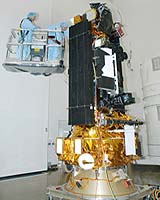
Vandenberg AFB CA (SPX) Jan 30, 2007 The Defense Meteorological Satellite Program (DMSP) F-17 Block 5D-3 spacecraft, built under contract for the U.S. Air Force by Lockheed Martin, has been turned over to the National Oceanic and Atmospheric Administration (NOAA) for operational use worldwide. The ceremony was held at the Air Force Weather Agency at Offutt Air Force Base in Omaha, Neb., which is the primary user of the satellite data within the United States. DMSP F-17 was launched on November 4, 2006 from Vandenberg Air Force Base, Calif. "After several years of building, integrating, upgrading and testing DMSP F-17, our second Block 5D-3 spacecraft, it is enormously satisfying that it is now beginning its vital mission of supporting our warfighters," said Michael O'Hara, Lockheed Martin DMSP program director. "Our partnership with the Air Force dates to the very beginning of the DMSP program with a common goal of ensuring that commanders have access to environmental data critical to the preparation and execution of military operations." The Block 5D-3 series accommodates larger sensor payloads than earlier generations. They also feature a larger capability power subsystem; a more powerful on-board computer with increased memory -- allowing greater spacecraft autonomy -- and increased battery capacity that extends the mean mission duration. Starting with F-17, the attitude control subsystem has also been enhanced with the integration of a second inertial measurement unit using ring laser, versus mechanical, gyros to provide greater precision pointing flexibility. DMSP is used for strategic and tactical weather prediction to aid the U.S. military in planning operations at sea, on land and in the air. Equipped with a sophisticated sensor suite that can image visible and infrared cloud cover and measure precipitation, surface temperature, and soil moisture, the satellite collects specialized global meteorological, oceanographic and solar-geophysical information in all weather conditions. The DMSP constellation comprises two spacecraft in near-polar orbits, C3 (command, control and communications), user terminals and weather centers. Following DMSP F-17, three satellites remain to be launched and are maintained at Space Systems' operations in Sunnyvale, Calif. for storage, functional testing, and upgrading. The spacecraft are shipped to Vandenberg for launch when requested by the Air Force. Since 1965, 44 Lockheed Martin DMSP satellites have been launched successfully by the U.S. Air Force. Now in its fourth decade of service, the DMSP has proven itself to be a valuable tool in scheduling and protecting military operations on land, at sea and in the air. The Space and Missile Systems Center at Los Angeles Air Force Base, Calif. manages the DMSP program. Community Email This Article Comment On This Article Related Links Weather News at TerraDaily.com Weather News at TerraDaily.com
 Millions Go Missing From The World Weather Organisation
 Geneva (AFP) Jan 22, 2007
Millions of Swiss francs have been embezzled from the World Meteorological Organisation (WMO), according to an internal audit quoted by the Swiss press Monday. Maria Veiga, the official who probed the scandal from 2003 to 2005, before being fired by the WMO in November, told Le Matin newspaper at least part of the missing 4.3 million Swiss francs (2.65 million euros) went to buy countries' votes. |
|
|

| The content herein, unless otherwise known to be public domain, are Copyright 1995-2006 - SpaceDaily.AFP and UPI Wire Stories are copyright Agence France-Presse and United Press International. ESA PortalReports are copyright European Space Agency. All NASA sourced material is public domain. Additionalcopyrights may apply in whole or part to other bona fide parties. Advertising does not imply endorsement,agreement or approval of any opinions, statements or information provided by SpaceDaily on any Web page published or hosted by SpaceDaily. Privacy Statement |