|
 |
 |
 |
 |
 |
 |
 |
 |

 |
Neutron Star Discovered Where A Black Hole Was Expected
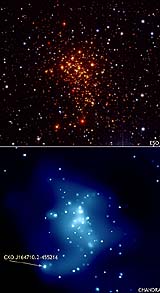
Cambridge MA (SPX) Nov 03, 2005 A very massive star collapsed to form a neutron star and not a black hole as anticipated, according to new results from NASA's Chandra X-ray Observatory. This discovery shows that nature has a harder time making black holes than previously thought. Scientists found this neutron star � a dense whirling ball of neutrons about 12 miles in diameter � in an extremely young star cluster. Astronomers were able to use well-determined properties of other stars in the cluster to deduce that the parent star of this neutron star was at least 40 times the mass of the sun. "Our discovery shows that some of the most massive stars do not collapse to form black holes as predicted, but instead form neutron stars,� said Michael Muno, a University of California, Los Angeles, postdoctoral Hubble fellow. He is lead author of a paper to be published in an upcoming edition of The Astrophysical Journal Letters. When very massive stars make neutron stars and not black holes, they will have a greater influence on the composition of future generations of stars. When the star collapses to form the neutron star, more than 95 percent of its mass, much of which is metal-rich material from its core, is returned to the space around it. "This means that enormous amounts of heavy elements are put back into circulation and can form other stars and planets," said J. Simon Clark of the Open University in the United Kingdom. Astronomers do not completely understand how massive a star must be to form a black hole rather than a neutron star. The most reliable method for estimating the mass of the parent star is to show that the neutron star or black hole is a member of a cluster of stars, all of which are close to the same age. Because more massive stars evolve faster than less massive ones, the mass of a star can be estimated if its evolutionary stage is known. Neutron stars and black holes are the end stages in the evolution of a star, so their parent stars must have been among the most massive stars in the cluster. The work described by Muno was based on two Chandra observations on May 22 and June 18, 2005. NASA's Marshall Space Flight Center, Huntsville, Ala., manages the Chandra program for NASA's Science Mission Directorate. The Smithsonian Astrophysical Observatory controls science and flight operations from the Chandra X-ray Center in Cambridge, Mass. Community Email This Article Comment On This Article Related Links SpaceDaily Search SpaceDaily Subscribe To SpaceDaily Express Black Hole Science and News
 MIT: SpInning Black Hole Leaves Dent In Space-Time
 Boston MA (SPX) Jan 12, 2006
MIT scientists and colleagues have found a black hole that has chiseled a remarkably stable indentation in the fabric of space and time, like a dimple in one's favorite spot on the sofa. |
|
|

| The content herein, unless otherwise known to be public domain, are Copyright 1995-2006 - SpaceDaily.AFP and UPI Wire Stories are copyright Agence France-Presse and United Press International. ESA PortalReports are copyright European Space Agency. All NASA sourced material is public domain. Additionalcopyrights may apply in whole or part to other bona fide parties. Advertising does not imply endorsement,agreement or approval of any opinions, statements or information provided by SpaceDaily on any Web page published or hosted by SpaceDaily. Privacy Statement |