|
 |
 |
 |
 |
 |
 |
 |
 |

 |
Neural Stem Cells Are Long-Lived
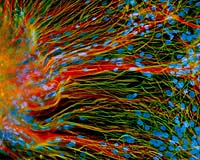
New York NY (SPX) Oct 06, 2005 New studies in mice have shown that immature stem cells that proliferate to form brain tissues can function for at least a year � most of the life span of a mouse � and give rise to multiple types of neural cells, not just neurons. The discovery may bode well for the use of these neural stem cells to regenerate brain tissue lost to injury or disease. Alexandra L. Joyner, a Howard Hughes Medical Institute investigator at New York University School of Medicine, and her former postdoctoral fellow, Sohyun Ahn, who is now at the National Institute of Child Health and Human Development, published their findings in the October 6, 2005, issue of the journal Nature. They said the technique they used to trace the fate of stem cells could also be used to understand the roles of stem cells in tissue repair and cancer progression. "In terms of using neural stem cells for therapeutic purposes and to regenerate tissue, it's important that they can continue to proliferate, and that these stem cells can make different cell types." Alexandra L. Joyner Joyner said that previous studies by her lab and others had shown that a regulatory protein called Sonic hedgehog (Shh) orchestrates the activity of an array of genes during development of the brain. Scientists also knew that Shh played a role in promoting the proliferation of neural stem cells. However, Joyner said the precise role of Shh in regulating stem cell self-renewal � the process whereby stem cells divide and maintain an immature state that enables them to continue to generate new cells � was unknown. In the studies published in Nature, Joyner and Ahn developed genetic techniques that enabled them to label neural stem cells in adult mice that are responding to Shh signaling at any time point so they could study which stem cells respond to Shh. Other researchers had shown that transient bursts of Shh signaling caused neural stem cells to proliferate and create new neurons. But a central question remained, said Joyner. At issue was whether resting, or quiescent, cells � which are important for long-term function � responded to Shh signaling. Or was the response limited to the actively dividing stem cells with a short life span involved in building new tissue? To test these options, the researchers used a chemical called AraC that selectively kills fast-dividing cells, leaving only quiescent cells. "This was an important experiment, because by giving AraC, we could kill all the cells that were actively dividing for a week," said Joyner. "And since the quiescent cells only divide every couple of weeks, they were spared." The researchers' observations revealed that the quiescent cells did, indeed, respond to Shh signaling, expanding to produce large numbers of neural cells. Even when the researchers gave the mice two doses of AraC separated by a year, the quiescent cells recovered � demonstrating that the cells could still respond to Shh signaling. That the quiescent stem cells remained capable of self-renewal after a year in both normal and AraC-treated mice was a central finding of the study, said Joyner. "It has been assumed that these cells probably live for some time, but it has never really been known whether they keep dividing, or divide a few times and give out," she said. The researchers also found evidence that neural stem cells in vivo responded to Shh signals by giving rise to other neural cell types, including glial cells that support and guide neurons. "An important point is that earlier studies indicating that neural stem cells could give rise to multiple cell types had been done in vitro," said Joyner. "Before our work, it had never been formally shown that they normally make those different cell types in vivo." Joyner and Ahn also found that the neural stem cell "niches" � the microenvironments in tissue that support and regulate stem cells � were not formed until late embryonic stages. Joyner said that the new findings have important clinical implications. "In terms of using neural stem cells for therapeutic purposes and to regenerate tissue, it's important that they can continue to proliferate, and that these stem cells can make different cell types," she said. In further studies, the researchers plan to use their technique of marking stem cells and tracing their fate to explore their role in repairing injured brain tissue in animal models. Such studies, she said, could reveal whether growth factors that influence stem cell growth could be used to treat brain injuries. "If these stem cells do produce cells that contribute to injury repair, it is fairly easy to infuse growth factors to coax these stem cells to do more in repairing injury," she said. Joyner and her colleagues are already discussing how to apply their genetic fate-mapping techniques to stem cells in the spinal cord and other organs. They are hopeful that since Shh signaling has been implicated in spurring the metastatic progression of cancer, the technique might also be used to explore the role of Shh signaling in tumor progression. Community Email This Article Comment On This Article Related Links New York University School of Medicine SpaceDaily Search SpaceDaily Subscribe To SpaceDaily Express Stem Cells News - Suppliers and Applications
 Adult Stem Cells Act As Construction Supervisors In Tissue Repair
 Charlottesville VA (SPX) Nov 24, 2005
For years it was believed that adult stem cells, under conditions of reduced oxygen - such as that found in victims of a heart attack or stroke - acted as building blocks by constructing new passageways for blood to bypass damaged tissue. |
|
|

| The content herein, unless otherwise known to be public domain, are Copyright 1995-2006 - SpaceDaily.AFP and UPI Wire Stories are copyright Agence France-Presse and United Press International. ESA PortalReports are copyright European Space Agency. All NASA sourced material is public domain. Additionalcopyrights may apply in whole or part to other bona fide parties. Advertising does not imply endorsement,agreement or approval of any opinions, statements or information provided by SpaceDaily on any Web page published or hosted by SpaceDaily. Privacy Statement |