|
 |
 |
 |
 |
 |
 |
 |
 |

 |
Neural Networking Nanotubes
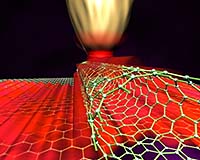
Ann Arbor MI (SPX) Nov 13, 2006 New implantable biomedical devices that can act as artificial nerve cells, control severe pain, or allow otherwise paralyzed muscles to be moved might one day be possible thanks to developments in materials science. Writing today in Advanced Materials, Nicholas Kotov of the University of Michigan, USA, and colleagues describe how they have used hollow, submicroscopic strands of carbon, carbon nanotubes, to connect an integrated circuit to nerve cells. The new technology offers the possibility of building an interface between biology and electronics. Kotov and colleagues at Oklahoma State University and the University of Texas Medical Branch have explored the properties of single-walled nanotubes (SWNTs) with a view to developing these materials as biologically compatible components of medical devices, sensors, and prosthetics. SWNTs are formed from carbon atoms by various techniques including deposition and resemble a rolled up sheet of chicken wire, but on a tiny scale. They are usually just a few nanometers across and up to several micrometers in length. The researchers built up layers of their SWNTs to produce a film that is electrically conducting even at a thickness of just a few nanometers. They next grew neuron precursor cells on this film. These precursor cells successfully differentiated into highly branched neurons. A voltage could then be applied, lateral to the SWNT film layer, and a so-called whole cell patch clamp used to measure any electrical effect on the nerve cells. When a lateral voltage is applied, a relatively large current is carried along the surface but only a very small current, in the region of billionths of an amp, is passed across the film to the nerve cells. The net effect is a kind of reverse amplification of the applied voltage that stimulates the nerve cells without damaging them. Kotov and his colleagues report that such devices might find use in pain management, for instance, where nerve cells involved in the pain response might be controlled by reducing the activity of those cells. An analogous device might be used conversely to stimulate failed motor neurons, nerve cells that control muscle contraction. The researchers also suggest that stimulation could be applied to heart muscle cells to stimulate the heart. They caution that a great deal of work is yet to be carried out before such devices become available to the medical profession. Community Email This Article Comment On This Article Related Links University of Michigan Oklahoma State University University of Texas Medical Branch Nano Technology News From SpaceMart.com Nano Technology News From SpaceMart.com Computer Chip Architecture, Technology and Manufacture
 Scientists Use Carbon Nanotube Networks To Detect Defects In Composites
 Newark DE (SPX) Oct 06, 2006
Two University of Delaware researchers have discovered a means to detect and identify damage within advanced composite materials by using a network of tiny carbon nanotubes, which act in much the same manner as human nerves. |
|
|

| The content herein, unless otherwise known to be public domain, are Copyright 1995-2006 - SpaceDaily.AFP and UPI Wire Stories are copyright Agence France-Presse and United Press International. ESA PortalReports are copyright European Space Agency. All NASA sourced material is public domain. Additionalcopyrights may apply in whole or part to other bona fide parties. Advertising does not imply endorsement,agreement or approval of any opinions, statements or information provided by SpaceDaily on any Web page published or hosted by SpaceDaily. Privacy Statement |