|
 |
 |
 |
 |
 |
 |
 |
 |

 |
Networking: 'Smart Highways' Emerging
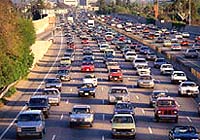
Chicago IL (UPI) Aug 02, 2005 Commuters cruise down Interstate 95 from New York City to Washington, D.C., bumper to bumper, at a speed of 120 miles per hour - about a two-hour trip at that speed. Do they worry about collisions? Not at all. They can even check the Dow Jones industrial average or browse new books on Amazon.com while they motor. Those commuters, sometime in the not-so-distant future, will be traveling along smart highways: networks of sensors connected to satellite links controlling collision-detection computers onboard the vehicles. The technology will do all the driving, experts told UPI's Networking. "There is simply no limit to what we can achieve as the technology improves," said Ed Schlesinger, founding director of the General Motors collaborative laboratory at the Carnegie Mellon University in Pittsburgh. "Cars will become nodes in a worldwide network delivering information to that network and getting information from it." Scientists and engineers at Carnegie Mellon and other leading research universities, as well as at the automakers in Detroit, are working on networking technologies that will enable vehicles to communicate and share data. These technologies will provide drivers with information about traffic flow, road conditions and even the optimal place to park. The networking also will help drivers alter their travel routes if conditions warrant, and even slow down to avoid a serious incident. "Though investments in technology have fallen off precipitously since the Internet implosion, there has been a renewed focus in this century on productive technology - not technology for technology's sake, but with a purpose, focus and bottom-line rationale," said Anthony J. Mayo, co-author of the forthcoming book, "In Their Time: The Greatest Business Leaders of the 20th Century" (Harvard Business Press, 2005). Indeed, according to Carnegie Mellon researchers, today's typical highway lane accommodates 2,000 vehicles per hour, but with networking and automation, that capacity could be expanded to 6,000. New peer-to-peer networks will monitor and control each vehicle's location and speed. Such an advance could reduce commute times - and increase worker productivity - dramatically, allowing more hours at the office instead of frittered away in traffic. Some of the early-stage versions of these exciting technologies already are being field-tested. Technicians at Motorola and General Motors are installing mesh networking at a number of race tracks around the globe, including a recent installation at the famed LeMans endurance race. The GM Corvette racing team placed first and second in that 24-hour race last month using the mesh networks, which provided pit crews with video feeds from the cockpit of the racecars. It gave the crews the ability to monitor and diagnose problems with the cars wirelessly. Soon, this technology could "also help improve the safety of the driving public on roads outside of the race track," said Gary Grube, a Motorola corporate vice president in Schaumburg, Ill., near Chicago. Another smart-highways project, conducted last year, demonstrated how a sensor-based traffic-management system could work. The project was undertaken by Siemens AG and a partner in California called E-View Safety Systems. In one dramatic facet, the test showed how emergency vehicles could take control of traffic lights while en route to ensure that ambulances arrived at the emergency rooms as quickly as possible. The highway of the future will incorporate a number of technologies, such as video and data transfer, as their prices continue to drop and their power and performance increase. "Computer-based technology, the foundation for much of the innovation in business since the 1980s, will undoubtedly continue to be refined in the new century," Mayo said. "Particularly as advances in wireless communications, data integration, video streaming and graphic transfer become more affordable and accessible." Community Email This Article Comment On This Article Related Links SpaceDaily Search SpaceDaily Subscribe To SpaceDaily Express Car Technology at SpaceMart.com
 Eclectic Koizumi Tries Electric Sedan
 Tokyo (AFP) Dec 19, 2005
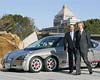
Never tired of sampling new ways to travel, Japanese Prime Minister Junichiro Koizumi whizzed around the grounds of parliament Monday in an eight-wheeled car billed as the world's fastest electric sedan. |
|
|

| The content herein, unless otherwise known to be public domain, are Copyright 1995-2006 - SpaceDaily.AFP and UPI Wire Stories are copyright Agence France-Presse and United Press International. ESA PortalReports are copyright European Space Agency. All NASA sourced material is public domain. Additionalcopyrights may apply in whole or part to other bona fide parties. Advertising does not imply endorsement,agreement or approval of any opinions, statements or information provided by SpaceDaily on any Web page published or hosted by SpaceDaily. Privacy Statement |