|
 |
 |
 |
 |
 |
 |
 |
 |

 |
Neptunium Goes Critical At Los Alamos
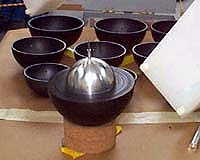
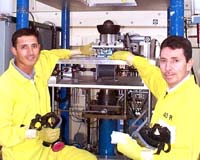
Los Alamos - Oct 18, 2002 A full-controlled criticality of the element neptunium was achieved in late September at Los Alamos National Laboratory's Technical Area 18 using a six kilogram nickel-clad neptunium sphere in combination with approximately 60 kilograms of enriched uranium. The experiment was conducted using the "Planet" assembly device at the Los Alamos Critical Experiments Facility or LACEF. The neptunium and enriched uranium assembly was constructed at TA-18's Critical Assembly and Storage Area-One, and mounted on the "Planet" device. The actual criticality was controlled remotely to assure the safety and security of the experiment. The experiment has yielded preliminary data that show the critical mass of neptunium is actually less than previously predicted. Following additional experimentation, the data will eventually pinpoint the element's exact critical mass, something that has not been determined before in the United States. Neptunium is an element produced as a by-product of nuclear power generation. Prior to this experiment, the critical mass of neptunium was only estimated with computer models from data based on earlier experiments using much smaller amounts of the element in less than optimal configurations. "The results of this experiment are of interest to scientists working in the fields of nuclear safeguards, nuclear nonproliferation and criticality safety," said Steve Clement of the Laboratory's Advanced Nuclear Technology group, part of the Nonproliferation and International Security Division. "While the actual criticality was achieved in about four days, this experiment has been in the works for 12 years, so on many levels, it's a major accomplishment." Neptunium is a man-made actinide metal, grayish in color, which lies on the periodic table of elements between uranium and plutonium. The isotope of neptunium used in this first criticality experiment was neptunium-237. The element has other isotopes that are very short lived, but neptunium-237 has an extraordinary long half-life of two million years. The International Atomic Energy Agency approved monitoring neptunium in 1999. Rene Sanchez and David Loaiza, both of Advanced Nuclear Technology, were primarily responsible for the successful criticality, along with a team that included Clement, Robert Kimpland, David Hayes, Peter Jaegers, Charlene Cappiello, Bill Myers, Ken Butterfield, Charles Hollas, Charles Goulding, Joetta Goda, Eric Sorensen and a support team of special nuclear materials custodians and others. "Fabrication of the sphere was completed about 18 months ago here at Los Alamos," said Sanchez. "Since then we've been in planning, getting permission from the Department of Energy to do the experiment and taking care of security issues.

|