|
 |
 |
 |
 |
 |
 |
 |
 |

 |
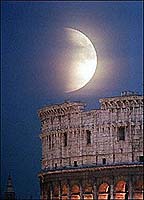
Neither Rome Nor Universe Built In A Day
Boston - June 27, 2002 The early evolution of the universe has confounded astronomers for years. Observations seem to show that giant black holes containing as much mass as three billion suns formed less than a billion years after the Big Bang. Collecting so much material so quickly was as unlikely as building a 20-room mansion in a day's time. Now, theoretical astrophysicists Stuart B. Wyithe and Abraham Loeb at the Harvard-Smithsonian Center for Astrophysics (CfA) have explained this paradox. They calculated that the light from a significant fraction of the most-distant quasars is likely being magnified by intervening matter, making the quasars' central black holes seem 10 to 100 times larger than they actually are. It's the equivalent of learning that what you thought was a 20-room mansion actually was a one-room shed, easily constructed in a day. The scientists reported their findings in the June 27, 2002, issue of the scientific journal Nature. Astronomers use quasars to study the early universe because they are bright enough to be seen from billions of light years away. Quasars are powered by supermassive black holes in the centers of galaxies. The black holes swallow large amounts of gas, creating powerful beacons of light that shine across the universe like cosmic lighthouses. "We can infer the minimum mass of the central black hole by measuring the amount of light it is generating. The brighter the light, the more massive the black hole 'engine' must be," said Wyithe. Within the past few years, astronomers have found quasars at very high redshifts that existed when the universe was less than one billion years old. Yet the light from these quasars indicates that they are powered by black holes containing as much matter as three billion suns. "This is a challenge. How do you form such big black holes so early?" said Loeb. "These supermassive black holes are found to exist in the young universe when it was less than one-tenth of its current age, yet they weigh as much as the most massive black holes in the universe today." Wyithe and Loeb solved the mystery by showing that the light of these distant quasars is likely to be gravitationally lensed. In gravitational lensing, the light traveling from the quasar is bent and magnified by the gravity of a galaxy between the quasar and the earth. Thus the quasar seems brighter, and the black hole seems more massive, than they actually are. The scientists' calculations show that as many as one-third of quasars with redshifts larger than 6 may be lensed. In comparison, less than one in a hundred of nearby quasars are lensed. The lensing of a high-redshift quasar may magnify its brightness by a factor of 10 or more. "The exact fraction of lensed quasars depends on how many fainter quasars existed at these early times," said Wyithe. "Inferring the lensed fraction from future observations will teach us about the abundance of quasars of different luminosities in the early universe." The next step in this research is to verify the frequency of gravitational lensing by direct observational data. Often, the intervening, lensing galaxy is too faint to be seen by any currently available telescope. However, the same lensing that magnifies the light from a quasar also tends to create multiple images of the quasar. These images are typically very close together in the sky, with separations of less than one second of arc (the width of a dime seen at a distance of about two miles). But large ground-based telescopes or NASA's Hubble Space Telescope can resolve the separate images in cases where they exist. Observational programs to take high-resolution images of high-redshift quasars are currently being planned, and will provide a direct measurement of the lensing rate. "Whether or not our calculations are confirmed by these observations, the results will tell us something useful about the early universe," said Loeb. Community Email This Article Comment On This Article Related Links Wyithe And Loeb's Paper Harvard-Smithsonian Center for Astrophysics SpaceDaily Search SpaceDaily Subscribe To SpaceDaily Express Nuclear Space Technology at Space-Travel.com
 JHU-STScI Team Maps Dark Matter In Startling Detail
 Baltimore MD (SPX) Dec 12, 2005
Clues revealed by the recently sharpened view of the Hubble Space Telescope have allowed astronomers to map the location of invisible "dark matter" in unprecedented detail in two very young galaxy clusters. |
|
|

| The content herein, unless otherwise known to be public domain, are Copyright 1995-2006 - SpaceDaily.AFP and UPI Wire Stories are copyright Agence France-Presse and United Press International. ESA PortalReports are copyright European Space Agency. All NASA sourced material is public domain. Additionalcopyrights may apply in whole or part to other bona fide parties. Advertising does not imply endorsement,agreement or approval of any opinions, statements or information provided by SpaceDaily on any Web page published or hosted by SpaceDaily. Privacy Statement |