|
 |
 |
 |
 |
 |
 |
 |
 |

 |
Nearby Supernova Factory Gets A Research Funding Boost
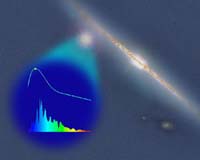
Berkeley CA (SPX) Sep 22, 2004 The Gordon and Betty Moore Foundation of San Francisco has awarded $2,377,000 to the University of California at Berkeley's Space Sciences Laboratory, in support of the Nearby Supernova Factory (SNfactory). The grant is intended to further dark energy research through the study and understanding of nearby Type Ia supernovae, a special class of very bright exploding stars. The grant is one of five the Moore Foundation has recently made to the University of California system in astronomy and astrophysics, including grants for the creation of a 30-meter telescope (with Caltech) and to the Mount Wilson Observatory, and grants for studies of stellar atmospheres and adaptive optics. The SNfactory grant, made through UC Berkeley's Space Sciences Laboratory, is directed to the "development of tools critical for greater understanding of Type Ia supernovae as indicators of dark energy." Co-principal investigators are Saul Perlmutter, a senior scientist in the Physics Division of the U.S. Department of Energy's Lawrence Berkeley National Laboratory and a professor of physics at UC Berkeley, and Michael Levi, also a member of Berkeley Lab's Physics Division and a senior fellow at UCB's Space Sciences Laboratory. This grant builds on the 1998 discovery by Perlmutter and his colleagues of "dark energy," a mysterious new energy that dominates the universe, causing it to fly apart at an accelerated rate. Astronomers and physicists are baffled by the nature of dark energy, which has become one of the leading scientific questions of our day. The best tools for answering this question are exploding stars known as Type Ia supernovae. "Because Type Ia supernovae are so bright, and so nearly uniform in their brightness, they are incomparable standard candles for studying the cosmos," says Perlmutter. "Comparing the brightness and redshift of distant Type Ia supernovae led us to the discovery that the expansion of the universe is accelerating. The same kinds of observations will be key to discovering the nature of the dark energy that drives that acceleration." Choosing among competing theories of dark energy, however, will require distant Type Ia's to be measured with unprecedented accuracy � partly by calibrating and matching these distant supernovae with more closely observed, nearby Type Ia's. In the past, observations of nearby Type Ia's have been unpredictable, frequently incomplete, and often not the best examples for comparison with their distant relatives. "Good as Type Ia supernovae are as standard candles, there is a residual uncertainty of a few percent in brightness measurements, and thus distance measurements," says Levi. "If that uncertainty is due to something that drifts with redshift, it would be significant to dark energy studies like SNAP, the SuperNova/Acceleration Probe satellite that is the leading candidate for DOE and NASA's Joint Dark Energy Mission." Levi, who is also co-principal investigator with Perlmutter for SNAP, says that "with this grant we also may learn how to make Type Ia supernovae even better astronomical standard candles � thus improving the science capabilities of SNAP and other future projects, something that we are keenly interested in doing.� Greg Aldering, the Berkeley Lab astronomer who leads the international SNfactory project, says, "We designed the SNfactory to discover hundreds of nearby Type Ia supernovae while they are still brightening." "The goal is to collect 300 such supernovae � close enough to measure with great precision but far enough away so their redshifts are relatively undistorted by the gravitational pull of their neighboring galaxies." The Moore Foundation grant will support the development of a high quality catalog of the brightnesses and spectra of these nearby supernovae. "We are delighted with the wisdom and foresight shown by the Moore Foundation in supporting cutting-edge research in the physical sciences," says Perlmutter, expressing a sentiment echoed by Levi. The investigators agree that "as a project at the intersection of physics and astronomy, there was no natural home for this research in the shrinking federal physical research portfolio." By capitalizing on the 1998 discovery by the Berkeley group and others that the expansion of the universe is accelerating, the Moore Foundation grant paves the way for further discoveries concerning the nature of dark energy and the ultimate fate of the universe." "The investigators affirm that "this grant will make a big difference in our attempts to understand why the universe is accelerating; it's a huge boost for us in this endeavor." The Gordon and Betty Moore Foundation was established in September 2000, by Intel co-founder Gordon Moore and his wife Betty. The Foundation funds outcome-based projects that will measurably improve the quality of life by creating positive outcomes for future generations. Grantmaking is concentrated in initiatives that support the Foundation's principal areas of concern: environmental conservation, science, higher education, and the San Francisco Bay Area. UC Berkeley's Space Sciences Laboratory is a campus-wide, multidisciplinary organization that serves to integrate work in space sciences on the UCB campus and to stimulate new programs of research. Community Email This Article Comment On This Article Related Links Berkeley Lab Berkeley's Space Sciences Laboratory SpaceDaily Search SpaceDaily Subscribe To SpaceDaily Express Nuclear Space Technology at Space-Travel.com
 Carina Nebula Dust Pillars Harbor Embedded Stars
 Boulder CO (SPX) May 31, 2005
Astronomers using NASA's Spitzer Space Telescope have imaged a giant molecular cloud being shredded by howling stellar winds and searing radiation, exposing a group of towering dust pillars harboring infant stars, according to a University of Colorado at Boulder researcher. |
|
|

| The content herein, unless otherwise known to be public domain, are Copyright 1995-2006 - SpaceDaily.AFP and UPI Wire Stories are copyright Agence France-Presse and United Press International. ESA PortalReports are copyright European Space Agency. All NASA sourced material is public domain. Additionalcopyrights may apply in whole or part to other bona fide parties. Advertising does not imply endorsement,agreement or approval of any opinions, statements or information provided by SpaceDaily on any Web page published or hosted by SpaceDaily. Privacy Statement |