|
 |
 |
 |
 |
 |
 |
 |
 |

 |
Nearby Extreme Galaxies Linked To Humble Roots
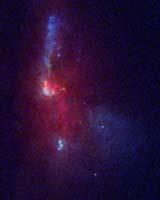
Calgary, Alberta (SPX) Jun 07, 2006 If you can't travel to the picturesque sands of Hawaii's Waikiki Beach, you can always do the next-best thing and visit a local shore. Both hot spots will provide plenty of sunshine. Astronomers are using a similar sightseeing tactic, studying nearby extreme galaxies known as luminous infrared galaxies to learn about their distant counterparts in the early universe. Astronomer Christine Wilson - of the Harvard-Smithsonian Center for Astrophysics in Cambridge, Mass. - and colleagues have found some surprising commonalities between these extreme galaxies and their mundane cousins, such as the Milky Way. "These galaxies are unusual in some ways, but surprisingly normal in others," Wilson said. "They're like giant sequoias - they look spectacular, but they grow from the same dirt as your basic shrub." Wilson presented her team's findings Monday at a news conference at the 208th meeting of the American Astronomical Society. Luminous and ultra-luminous infrared galaxies are islands of stars and dust that emit the great majority � 90 percent to 99 percent - of their light at long infrared wavelengths. All known examples show evidence for galaxy interactions and mergers that are stirring them up. Gas and dust crash together at the centers of these galaxies, fueling tremendous bursts of star formation or feeding giant central black holes. "All the action in these galaxies is happening at their centers," Wilson said. Similar interactions were much more common in the early universe when galaxies were closer together. Observations have detected many examples of extreme galaxies at distances of 8 billion to 10 billion light-years. At those great distances, detailed study is difficult with current instruments, hence astronomers' interest in their nearby counterparts. To investigate these galactic hot spots, Wilson and her colleagues employed the Smithsonian's Submillimeter Array. The high spatial resolution of the array was crucial for this study, allowing the team to probe galactic centers, where most of the star formation is taking place. "Some of these galaxies have as much gas as the Milky Way crammed into a region only 2,000 light-years across - one-fiftieth the size of our galaxy," Wilson said. About three-fourths of the time, that gas powers bursts of star formation. In other cases, the gas feeds a giant black hole. Either way, a lot of energy gets pumped out in infrared wavelengths. Wilson and colleagues determined the total amounts of gas and dust within each of the five most luminous galaxies they studied. They divided the two numbers to calculate the gas-to-dust ratio. Galaxies such as the Milky Way typically contain about 100 times more gas than dust. Surprising, but the extreme infrared galaxies showed similar values. "Given their unusual environment, I'm not sure I would have expected to see a normal gas to dust ratio," Wilson said. "The fact that we do see a normal value suggests not only that our mass calculations are correct, but also that these galaxies are more like our own than we might have guessed." Luminous infrared galaxies also show some interesting differences from their cousins in the early universe. For example, distant galaxies typically are 10 times brighter in molecular emissions, a finding that indicates they contain more gas. That gas also tends to move faster, suggesting the galaxies are more massive. Most interesting, distant extreme galaxies appear to be larger in size, which suggests the gas density actually might be lower in these distant galaxies despite their larger total amount of gas. Future work by Wilson and her team will focus on determining how galaxy properties change as interactions and mergers progress over time. Community Email This Article Comment On This Article Related Links Submillimeter Array Stellar Chemistry, The Universe And All Within It
 Astronomers Find Most Distant Galaxy Cluster Yet
 Calgary, Alberta (SPX) Jun 7, 2006
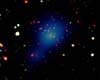
Astronomers have found the most distant cluster of galaxies to date and possibly the most massive one yet seen at such an early era in the universe. |
|
|

| The content herein, unless otherwise known to be public domain, are Copyright 1995-2006 - SpaceDaily.AFP and UPI Wire Stories are copyright Agence France-Presse and United Press International. ESA PortalReports are copyright European Space Agency. All NASA sourced material is public domain. Additionalcopyrights may apply in whole or part to other bona fide parties. Advertising does not imply endorsement,agreement or approval of any opinions, statements or information provided by SpaceDaily on any Web page published or hosted by SpaceDaily. Privacy Statement |