|
 |
 |
 |
 |
 |
 |
 |
 |

 |
Near-Real Time Ozone Forecasting Made Possible By Envisat
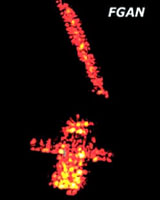
Paris (ESA) Nov 04, 2003 Stratospheric data supplied by Envisat are the basis for a near-real time global ozone forecasting service now available online. Up in the stratosphere about 25 km above our heads is the ozone layer. Stratospheric ozone absorbs up to 98% of the Sun's harmful ultraviolet light � making the difference between a suntan and sunburn, and safeguarding all life on Earth. But chemical activity in the stratosphere ultimately due to the presence of manmade gases such as chlorofluorocarbons (CFCs) can thin the ozone layer. The Brussels-based Belgian Institute for Space Aeronomy (BIRA-IASB from its initials in Flemish and French) has developed a service called the Belgian Assimilation System of Chemical Observations from Envisat (BASCOE) that maps and forecasts not only the concentration of ozone in the stratosphere but also 56 other chemical species, including those responsible for ozone depletion. BASCOE relies on an instrument aboard Envisat called the Michelson Interferometer for Passive Atmospheric Sounding (MIPAS). It works day and night to measure infrared emissions from the Earth's 'limb' � the narrow band of atmosphere between the planetary surface and empty space. Emissions along certain wavelengths work like signatures, indicating the presence of specific atmospheric chemicals. MIPAS has the capability to measure up to 30 trace gas species, but for the time being only a subset of them is provided by the ESA ground segment operationally to the user community. The others whose concentrations are forecast by BASCOE have their presence calculated indirectly, by assimilating MIPAS level 2 products into a complex computer model of stratospheric chemistry processes developed by BIRA-IASB. The resultant analyses are available within a day. "The stratosphere is one of the best-understood areas of atmospheric chemistry, a fact which makes the BASCOE model possible," explained Dominique Fonteyn of BIRA-IASB. "In fact this model predates the launch of Envisat, and was originally intended simply as a summary of our existing understanding of stratospheric chemistry. But the large amount of work that went into it � some 50,000 lines of code � made us look at using it in other ways, and assimilating Envisat data into it for operational use. "The aim was to reduce the usual time delay between satellite observation and data use, in the same way weather forecasting does. As well as chemical interactions, the model also includes weather data provided by the European Centre for Medium Range Weather Forecasts, because polar stratospheric clouds transported by winds play a major role in the process of ozone destruction." Users of the service can obtain forecasts of global ozone levels for the week ahead as well as maps of nitric acid trihydrate (NAT) and active chlorine (ClOx), both implicated in ozone thinning. The intention to use the MIPAS data to 'fine-tune' the model in future for increased accuracy, along with assimilating data from other Envisat instruments such as GOMOS (Global Ozone Monitoring by Occultation of Stars) and SCIAMACHY (Scanning Imaging Absorption Spectrometer for Atmospheric Cartography) once they become available. Community Email This Article Comment On This Article Related Links BASCOE Envisat Results MIPAS video BIRA-IASB SpaceDaily Search SpaceDaily Subscribe To SpaceDaily Express Earth Observation News - Suppiliers, Technology and Application
 New Legislation Initiated To Support Commercial Remote Sensing Industry
 New York NY (SPX) Jan 11, 2006
The importance of remotely sensed data and technologies to support natural disasters has prompted attention and action in Washington. New initiatives and legislation authorizing appropriations to the remote sensing industry will be discussed at Strategic Research Institute's U.S. Commercial Remote Sensing Industry conference, scheduled for February 9-10, 2006 in Washington D.C. |
|
|

| The content herein, unless otherwise known to be public domain, are Copyright 1995-2006 - SpaceDaily.AFP and UPI Wire Stories are copyright Agence France-Presse and United Press International. ESA PortalReports are copyright European Space Agency. All NASA sourced material is public domain. Additionalcopyrights may apply in whole or part to other bona fide parties. Advertising does not imply endorsement,agreement or approval of any opinions, statements or information provided by SpaceDaily on any Web page published or hosted by SpaceDaily. Privacy Statement |