|
 |
 |
 |
 |
 |
 |
 |
 |

 |
Near-Earth Asteroid is Two Chunks in One
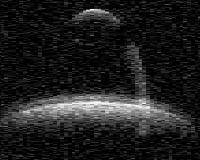
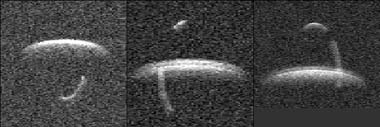
Pasadena - May 30, 2001 The clearest radar pictures of a near-Earth double asteroid system were taken by astronomers last week using NASA's Goldstone radar telescope, revealing clues to the system's current structure but raising questions about its origin and future. A team of astronomers studied images that show the trail of the smaller component orbiting a larger object, made with the Goldstone radar, a 70-meter (230-foot) antenna in California's Mojave Desert. The asteroid, 1999 KW4, came within five million kilometers of Earth (over 3 million miles) on Friday, May 25. "This system, 1999 KW4, is the third binary near-Earth asteroid pair revealed by radar, but this is the first time we've been able to image the system over a complete orbit of one component around the other," said Dr. Steven Ostro of NASA's Jet Propulsion Laboratory, Pasadena, Calif., leader of the team that made the discovery. "Goldstone was able to track the asteroid for up to eight hours daily for a week. Then we made close-up images of each component using the Arecibo telescope in Puerto Rico, which is not as fully steerable but is much more powerful." The radar team also included Dr. Lance Benner and Jon Giorgini of JPL, Dr. Jean-Luc Margot of the California Institute of Technology, Pasadena, and Dr. Michael Nolan of Arecibo Observatory, Arecibo, Puerto Rico. "The asteroid pair 1999 KW4 is classified a Potentially Hazardous Asteroid because eventually its path through space could intersect Earth. However, the radar measurements, which are accurate to 15 meters (about 49 feet), indicate there is no significant chance of 1999 KW4 colliding with Earth for at least a thousand years," said Giorgini. He said the larger component is spheroidal and roughly 1.2 kilometers (three-quarters of a mile) in average diameter, while the smaller component is asymmetrical and roughly one-third as large. "1999 KW4 is one of fewer than two dozen known asteroids whose orbits cross the orbits of Mercury, Venus and Earth," said Benner. "However, the only known solar system bodies that get closer to the Sun and have a more steeply inclined orbit than 1999 KW4 are comets, so perhaps this object is an extinct comet nucleus." "Our first look at the images suggests an orbital period of roughly 16 hours," said Margot. Later, detailed analysis of all the radar data will determine very precisely the period, which is the time it takes the smaller object to orbit the larger one. Using the laws of celestial mechanics, the team will measure the objects' masses and densities, which will tell what they are made of and how porous they are. For single asteroids, that kind of information can only be obtained by sending a spacecraft close to the body, and so most asteroids' densities, compositions and meteorite associations are not well known. "Yet this kind of information is the key to understanding relationships between meteorites, near-Earth asteroids, main-belt asteroids and comets," said Margot. "This might be the first discovery of an ex-comet's density," said Dr. Don Yeomans, head of NASA's Near Earth Object program office at JPL. Three known objects are officially designated both an asteroid and a comet. "The existence of binary near-Earth asteroids raises perplexing questions about their origins," said Nolan. "Nobody understands exactly how binary asteroid systems formed, or even how stable the current binary systems are, that is, how they might evolve, with the two components either separating completely or collapsing onto one another to form a contact binary. The theoreticians really have their work cut out for them now." Nolan said that the near-Earth binary systems might have formed during certain kinds of collisions. Or, if they came from loosely bound, unconsolidated piles of rubble instead of solid rocks, binary asteroids might have formed during close passages by Earth when gravity pulls them apart. The first binary asteroid was found in August 1993 when NASA's Galileo spacecraft took pictures of asteroid Ida and revealed its tiny moon Dactyl. Current statistics suggest that at least several percent of the near-Earth asteroids are binaries. Ostro said that the existence of binary asteroids on potentially hazardous orbits means that we have to start figuring out how to maneuver spacecraft close to such objects. "Robotic spacecraft, and eventually people, are destined to go to such objects someday, either for defense against one of them, to exploit mineral resources, to satisfy our curiosity about what they're like close-up or simply for the adventure of exploring a diminutive double world," Ostro said.

|