|
 |
 |
 |
 |
 |
 |
 |
 |

 |
Navy test fires powerful electromagnetic 'railgun'
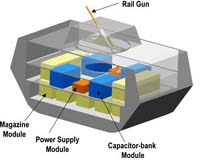
Washington (AFP) Jan 31, 2008 The US Navy test fired the world's most powerful electromagnetic railgun Thursday, launching a projectile at a velocity of 2,500 meters per second, or 5,600 miles per hour, into a bunker. The test marks the latest step in US efforts to develop a futuristic naval gun that can hit a target more than 200 nautical miles away with a non-explosive slug traveling at between five and seven times the speed of sound. Instead of chemical propellants, the rail gun uses electromagnetic energy to propel a slug along rails before launching it at a velocity of about Mach 7, officials said. "The gun is designed to launch these projectiles extremely far, somewhere in the neighborhood of 200 nautical miles, and their impact velocity is extremely high, somewhere in the vicinity of Mach 5," said Jim Boyle, a spokesman for the Office of Naval Research. "So it is an extremely fast moving, long range system," he said. The test model bears little resemblance to a gun. Instead, thick black cables plug into the rear of what looks like a long rectangular grill. That armature holds the rails together as a powerful electric current surges through them, pushing the slug forward. In Thursday's test, the most powerful charge ever -- 10.64 megajoules of energy -- was sent coursing through the railgun. (A joule is the amount of energy needed to lift an apple a meter straight up.) It caused the round to accelerate to a velocity of "just slightly over 2,500 meters per second," or 5,600 miles an hour, said Colin Babb, another navy spokesman. The slug was blasted only about 20 meters (70 feet) into a bunker lined with metal boxes filled with sand. "At this phase of the project, they are working solely on the science and technology related to the barrel of the gun, so they are interested in how projectiles interact with the rails," said Babb. "At this facility and in this test, they are not doing anything with regard to range, how far it goes, what the projectile does per se," he said. Although the 237 million dollar program is still in its initial phases, the navy believes it holds promise for use on future electric powered warships. A working railgun would allow warships to operate a greater distances from their targets, and improve safety and storage space on board ships by doing away with explosive warheads and propellants. Some experts believe railguns also might be useful in targeting ballistic missiles. Community Email This Article Comment On This Article Related Links The latest in Military Technology for the 21st century at SpaceWar.com
 DRS Tech Gets Contract To Supply Marine Corps With Rugged Tablet Computers
 Parsippany NJ (SPX) Jul 10, 2007
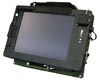
DRS Technologies has received a $5 million award as part of a previous contract to provide military rugged tablet (MRT) computers and peripheral equipment for the U.S. Marine Corps' Target Location Designation Handoff System (TLDHS) program. DRS received the order from Stauder Technologies in St. Peters, Missouri. For this contract the company's DRS Tactical Systems business unit in Melbourne, Florida, will produce hundreds of the handheld MRT computers and peripheral equipment. |
|
|

| The content herein, unless otherwise known to be public domain, are Copyright 1995-2007 - SpaceDaily.AFP and UPI Wire Stories are copyright Agence France-Presse and United Press International. ESA Portal Reports are copyright European Space Agency. All NASA sourced material is public domain. Additional copyrights may apply in whole or part to other bona fide parties. Advertising does not imply endorsement,agreement or approval of any opinions, statements or information provided by SpaceDaily on any Web page published or hosted by SpaceDaily. Privacy Statement |