|
 |
 |
 |
 |
 |
 |
 |
 |

 |
Navy Sends Scientists To Arctic Ice Camp
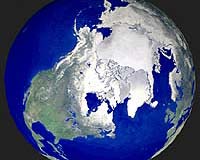
Washington - Apr 30, 2003 In late March, the U.S. Navy established a camp on a severe and unforgivingly cold stretch of ice about 150 miles north of Deadhorse, Alaska. While most of us were looking forward to the long, hot, sultry days of summer, nearly 30 scientists eagerly accepted an Office of Naval Research invitation to head to the Arctic camp to study ice, sea, and atmosphere. An interdisciplinary team of research scientists is focusing on the physical, biological, and chemical environment of the ice-covered ocean, and will provide the first late winter data on sea ice in the Beaufort Sea since 1997. Ice Experiment 03, dubbed ICEX 03, will assess both current conditions and dramatic interannual changes in the Arctic � such as decreased thickness and extent of the ice pack cover � that have affected the region over the past decade. Take temperature for instance. "Rapid change in Arctic temperature is like the canary in the coal mine," explains Dennis Conlon, Arctic scientist at ONR. "Arctic ice cover affects Earth's temperature. The less ice there is to reflect sunlight back into space, the warmer we get. This ice camp gives researchers the chance to gather data and to help the Navy better understand the Arctic operational environment." The ice camp sits on waters that are a mixture of the boundary current flowing along the continental margins around the Arctic Ocean, input from the Bering Strait, and dense waters from the shallow continental shelves. Scientists are documenting the physical conditions of these waters, including currents and the nutrients and elements they carry. One project will examine the arctic atmosphere to measure mercury levels to understand the controls of sea ice over atmospheric mercury deposition. This will contribute to our understanding of "Arctic haze" (believed to be composed of industrial pollution from lower latitudes) and the health of marine mammals in the region. Using data from satellites, airplanes, and in situ measurements, researchers are verifying remote sensing methods and models. Biologists are studying ice algae and its role in the Artic food web. Several projects are being undertaken as part of the Shelf-Basin Interaction (SBI) program, funded by ONR and the National Science Foundation, which aims to assess climate change in the Arctic. In addition to scientists from the National Ice Center, the Univ. of Alaska Fairbanks, the Jet Propulsion Laboratory, and other research institutions, a team of specialists studying the ice cover on Jupiter's moon Europa will use the camp to gain "hands-on" experience with sea ice. In April 2001, the Office of Naval Research co-sponsored a meeting of Arctic subject matter experts from the U.S., Canada, and Great Britain in a preliminary attempt to address a range of Arctic issues. That report, and a complete list of ICEX 03 participants, is available. Community Email This Article Comment On This Article Related Links Office of Naval Research SpaceDaily Search SpaceDaily Subscribe To SpaceDaily Express Dirt, rocks and all the stuff we stand on firmly
 Magnetic Reconnection Region Larger Than 2.5 Million Km Found In The Solar Wind
 Paris (ESA) Jan 12, 2006
Using the ESA Cluster spacecraft and the NASA Wind and ACE satellites, a team of American and European scientists have discovered the largest jets of particles created between the Earth and the Sun by magnetic reconnection. This result makes the cover of this week's issue of Nature. |
|
|

| The content herein, unless otherwise known to be public domain, are Copyright 1995-2006 - SpaceDaily.AFP and UPI Wire Stories are copyright Agence France-Presse and United Press International. ESA PortalReports are copyright European Space Agency. All NASA sourced material is public domain. Additionalcopyrights may apply in whole or part to other bona fide parties. Advertising does not imply endorsement,agreement or approval of any opinions, statements or information provided by SpaceDaily on any Web page published or hosted by SpaceDaily. Privacy Statement |