|
 |
 |
 |
 |
 |
 |
 |
 |

 |
Navigators Score Precise Mars Landing Result
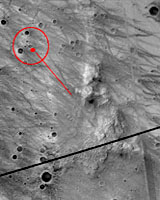
Pasadena (JPL) Jan 04, 2004 Anyone who's been blindfolded and spun around knows how hard it is to "pin the tail on the donkey," even though players are pointed in the right direction when they last look at their target. To land in a precise location on Mars after traveling over 300 million miles, navigators at the Jet Propulsion Laboratory (JPL) had to overcome the head-spinning challenges of calculating the exact speeds of a rotating Earth, a rotating Mars, and a rotating spacecraft, while they all simultaneously are spinning in their own radical orbits around the Sun. All the hard work paid off January 3 when navigators hit their target at the top of the martian atmosphere to within about 200 meters (660 feet), setting a new standard for navigation accuracy for all future interplanetary missions. "The trajectory was so perfect that not only was it within 200 meters, we also didn't need to adjust course in the final eight days of cruise," said Dr. Michael Watkins, navigation and mission design manager at JPL. Navigators canceled two trajectory correction maneuvers that were scheduled to correct the flight path by firing a series of small engine thrusters. The navigation team researched the exact performance of the engine thrusters to a tiny fraction of a millimeter per second to ensure flawless aiming for the four previous maneuvers. "The Mars Exploration Rover spacecraft design team helped our ability to navigate precisely in the sense that they created a dynamically quiet spacecraft. Spirit didn't thrust much during prior trajectory maneuvers because the spacecraft was spinning for stability, and when it did thrust, it did so in a way that was easy for navigators to predict movement," said Watkins. Spacecraft thruster firings are a significant effect navigators have to deal with, but even the seemingly insignificant solar radiation pressure and thermal radiation forces acting on the spacecraft to a level equal to less than a billionth of the acceleration of gravity one feels on the Earth need to be taken into account. Without knowing the acceleration error to that degree, the spacecraft would have moved off course by 3.7 km (2.3 miles) over 10 days. "We had to know everything from how the iron molten lava in the center of the Earth was churning to how plate tectonic movements were affecting the wobble of the Earth to how the plasma in the atmosphere delayed the radio signals to and from the Deep Space Network stations," explained Dr. Louis D'Amario, Mars Exploration Rover navigation team chief. "We assembled the best navigation team in the world with experts in orbit determination, propulsive maneuver design, and entry, descent, and landing trajectory analysis," said D'Amario. The navigation team has been working extremely hard on this mission for three years - they even sacrificed their holidays this December and New Year's Eve, and they have essentially worked around the clock for the last two weeks. Navigators use radio signals sent and received by the Deep Space Network (DSN) antennas on Earth to compute spacecraft position and velocity. Three DSN sites are roughly equally spread around Earth's globe at 120-degree intervals, so that antennas are pointed toward Mars at any given time as the Earth turns. If the exact location of any of these antennas is incorrect by just 5 centimeters (2 inches) on the surface of Earth, that math error builds over the 150 million kilometers (90 million miles) distance between Earth and Mars, creating a 1500-foot (0.3-mile) location error at Mars. So hitting a precise landing site target that is scientifically interesting on Mars is impossible unless the calculations of how fast Earth is rotating on its own axis is known to the timing of 0.2 milliseconds. At the other end of the journey, navigators must also know the location of Mars to the level of accuracy of several hundred meters. Using recent measurements with Mars Global Surveyor and Mars Odyssey, navigators know the location of Mars relative to the Earth to half a mile or less. The navigation team's intense attention to detail was focused on ensuring that this mission would be the most accurately navigated in history. Navigators ran up to 1,000 different location accuracy solutions several times every day to cover the full range of possible answers. The navigation team also used a tongue-tying tracking technique called spacecraft-quasar delta differential one-way range or DDOR (pronounced "Delta Door"), which utilized their knowledge of locations of quasars to a few billionths of a degree to help locate the spacecraft's motion in the "up or down" direction in the sky. "Even though it was seemingly impossible to reach the small science-rich landing site inside Gusev Crater, the dedicated navigation team hit the bulls-eye tonight to put us in position for a winning science mission," Watkins said. Community Email This Article Comment On This Article Related Links Mars Rovers at JPL Mars Rovers at Cornell SpaceDaily Search SpaceDaily Subscribe To SpaceDaily Express Mars News and Information at MarsDaily.com Lunar Dreams and more
 Spirit Heading To 'Home Plate'
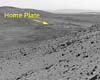 Pasadena CA (JPL) Jan 09, 2006
Last week Spirit completed robotic-arm work on "El Dorado." The rover used all three of its spectrometers plus the microscopic imager for readings over the New Year's weekend. |
|
|

| The content herein, unless otherwise known to be public domain, are Copyright 1995-2006 - SpaceDaily.AFP and UPI Wire Stories are copyright Agence France-Presse and United Press International. ESA PortalReports are copyright European Space Agency. All NASA sourced material is public domain. Additionalcopyrights may apply in whole or part to other bona fide parties. Advertising does not imply endorsement,agreement or approval of any opinions, statements or information provided by SpaceDaily on any Web page published or hosted by SpaceDaily. Privacy Statement |