|
 |
 |
 |
 |
 |
 |
 |
 |

 |
Navigating Without Starlight
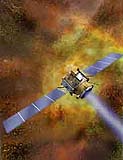
Pasadena - December 24, 1999 - The Deep Space 1 spacecraft executed a highly successful and innovative set of maneuvers on Wednesday, December 15 in the first test of new ways of controlling the spacecraft now that the star tracker is not working and is unlikely to resume operation. The star tracker, imaginatively so named because it tracks stars, helps determine the spacecraft's orientation; this is not one of the 12 advanced technologies whose testing was the focus of DS1's primary mission, but it is a new and sophisticated device. It is not part of the navigation system but is part of what engineers call the attitude control system. Among its many responsibilities, the attitude control system determines how the spacecraft is oriented, and it was designed to use the star tracker in doing so. Let's imagine the job that has to be done. The spacecraft is in the solar system, far from any of the planets. How can it orient itself? Well, how do you orient yourself? You need several references. First of all, you know that gravity is pulling you "down". That gives one direction. In the same way, the spacecraft has a sensor that can see the Sun, so that gives it one direction. But knowing which way is down is not enough for you, because you don't know what direction you are facing. On Earth, you can use a compass or familiar landmarks to determine that. The compass won't work in space, but there are familiar landmarks, namely the stars. If you knew the constellations, you could determine which direction you were facing on Earth. In much the same way, the star tracker recognizes patterns of stars, so it could tell the spacecraft what direction it was facing. Now that the star tracker has stopped working, the spacecraft cannot know what its orientation is. In that case, we can't tell it how to point the ion engine to fire in the right direction, or how to point the science camera to take pictures. You can understand the problem by imagining that you are in a dark room and you have a flash camera. You don't know which way you are facing, so if I tell you to take a flash picture of a certain part of the room, you can't do it. Without the star tracker, the spacecraft has been using its Sun sensor to point its main antenna and solar arrays at the Sun and rotating once per hour, at just the same slow rate that the minute hand on a clock moves. Of course, sophisticated electronic devices occasionally fail, and when they do on Earth we usually fix them or replace them, but that's generally not an option with a spacecraft farther away than the Sun. So the DS1 team is designing new ways to operate the spacecraft without it. The team's major efforts now are devoted to developing new techniques to turn and point the spacecraft without the star tracker. It is an exciting and interesting problem to solve and represents another challenge for the mission that has so successfully accomplished so many remarkable feats. Before commanding the spacecraft, the operations team conducted extensive tests with the Deep Space 1 test facility at JPL. This is a simulation of the spacecraft, created using some hardware similar to what is on the real spacecraft and some computer programs that emulate the behavior of other parts of the spacecraft. Then on December 15, the spacecraft was commanded to run through the same set of instructions that had been developed in the test facility. The tests including stopping the stately rotation and turning the spacecraft so that it was no longer pointing its antenna at the Sun. Then it tested two different ways to turn 10� and stop. Next, the spacecraft was commanded to rotate so that one of its antennas swept out a cone. During this three-hour maneuver, the antenna pointed at Earth for a portion of each one-hour turn, just as it was supposed to. Then it switched to using its more powerful antenna, and that antenna slowly swept past Earth. The spacecraft then stopped rotating and held its position. Finally, at the end of the test it was instructed to return to the starting configuration of pointing at the Sun and rotating slowly. Throughout the tests, a number of the large 34-meter (112-feet) and 70-meter (230-feet) antennas at NASA's Deep Space Network were used to monitor and record the strength of the spacecraft's radio signal. This procedure was difficult, because the signal strength varied a great deal as the tiny and tremendously distant spacecraft executed its maneuvers, but the Deep Space Network team performed flawlessly. The detailed results of the successful maneuvering are being analyzed now, including comparing them with the tests run in the test facility, and they will be used to develop future tests, all leading to the capability to fly the spacecraft without the star tracker. In addition to devising new ways of operating the spacecraft, the team is working on determining why the star tracker stopped functioning. Although Deep Space 1 successfully completed its primary mission in September, this is a very important job, as there are future missions that will rely on star trackers similar to this one. So JPL and the manufacturer of the device are working together to understand what might have caused the problem, thus helping other missions avoid it. Deep Space 1 is now over 1.6 times farther away from Earth than the Sun is and over 640 times as far as the moon. At this distance of 246 million kilometers, or 153 million miles, radio signals, traveling at the universal limit of the speed of light, take 27.5 minutes to make the round trip.
Email This Article Comment On This Article Related Links Space
 Satellite Launch To Boost DTH In India
 Calcutta, India (SPX) Dec 28, 2005
The successful launch Thursday of India's heaviest satellite from spaceport of Kourou in French Guyana may have boosted the country's space research efforts to yet another level, but it has also lifted the spirits of at least three Direct-To-Home televisions broadcasters, one of which has been waiting for years to launch its services in India. |
|
|

|
|
|
|
|
|
|
|
|
|
|
|
| The content herein, unless otherwise known to be public domain, are Copyright 1995-2006 - SpaceDaily.AFP and UPI Wire Stories are copyright Agence France-Presse and United Press International. ESA PortalReports are copyright European Space Agency. All NASA sourced material is public domain. Additionalcopyrights may apply in whole or part to other bona fide parties. Advertising does not imply endorsement,agreement or approval of any opinions, statements or information provided by SpaceDaily on any Web page published or hosted by SpaceDaily. Privacy Statement |