
 |
 |
 |
 |
 |
 |
 |
 |
 |

 |
Natural Selection May Not Produce The Best Organisms
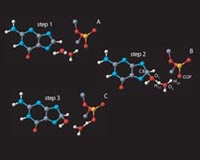
Washington DC (SPX) Jul 22, 2008 "Survival of the fittest" is the catch phrase of evolution by natural selection. While natural selection favors the most fit organisms around, evolutionary biologists have long wondered whether this leads to the best possible organisms in the long run. A team of researchers at The University of Texas at Austin, led by Drs. Matthew Cowperthwaite and Lauren Ancel Meyers, has developed a new theory, which suggests that life may not always be optimal. The results of this study appear July 18th in the open-access journal PLoS Computational Biology. Genetic mutations create the raw material that natural selection acts upon. The short-term fate of a mutation is often quite clear. Mutations that make organisms more fit tend to persist through generations, while harmful mutations tend to die off with the organisms that possess them. The long-term consequences of mutations, however, are not well understood by evolutionary biologists. The researchers have shown that what may be good in the short run, may hinder evolution in the long run. The team developed computer models of RNA molecules evolving by mutation and natural selection. RNA molecules, which are very similar to DNA, play key roles in essential life processes and serve as the genetic material for some of our deadliest viruses, including influenza and HIV. Their computer models show that the evolution of optimal organisms often requires a long sequence of interacting mutations, each arising by chance and surviving natural selection. As Cowperthwaite explains, "Some traits are easy to evolve - formed by many different combinations of mutations. Others are hard to evolve - made from an unlikely genetic recipe. Evolution gives us the easy ones, even when they are not the best." The group's analysis of RNA molecules from a wide variety of species suggests that life is indeed dominated by the "easy" traits, perhaps at the expense of the best ones. Community Email This Article Comment On This Article Share This Article With Planet Earth
Related Links The Ascent of the Abundant: How Mutational Networks Constrain Evolution Darwin Today At TerraDaily.com
 Vocal Communication Evolved With Ancient Species
 Ithaca NY (SPX) Jul 22, 2008
It's a long way from the dull hums of the amorous midshipman fish to the strains of a Puccini aria - or, alas, even to the simplest Celine Dion melody. But the neural circuitry that led to the human love song - not to mention birdsongs, frog thrums and mating calls of all manner of vertebrates - was likely laid down hundreds of millions of years ago with the hums and grunts of the homely piscine. |
|
|

| The content herein, unless otherwise known to be public domain, are Copyright 1995-2007 - SpaceDaily.AFP and UPI Wire Stories are copyright Agence France-Presse and United Press International. ESA Portal Reports are copyright European Space Agency. All NASA sourced material is public domain. Additional copyrights may apply in whole or part to other bona fide parties. Advertising does not imply endorsement,agreement or approval of any opinions, statements or information provided by SpaceDaily on any Web page published or hosted by SpaceDaily. Privacy Statement |
 del.icio.us
 Digg
Digg Reddit
 YahooMyWeb
 Google
 Facebook