|
 |
 |
 |
 |
 |
 |
 |
 |

 |
National Research Council Committee Backs National Underground Lab
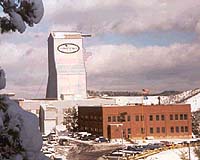
Albuquerque - Apr 22, 2002 The effort to create a National Underground Science Laboratory received a major endorsement during the weekend from the National Research Council's Committee on the Physics of the Universe. The NRC committee stressed the need for a deep laboratory in a report presented Sunday at an American Physical Society national meeting in Albuquerque, N.M. The committee's chairman, University of Chicago physicist Michael Turner, noted that such a laboratory would allow the United States to leap to the head of international efforts in underground science. The report calls for the National Science Foundation and federal Department of Energy to cooperate in financing experiments the laboratory would house. A proposal pending before the NSF, formulated last year by a national consortium of scientists led by the University of Washington, recommends a national underground lab be created at the recently closed Homestake Gold Mine in South Dakota. In its 125-year history, Homestake became the deepest gold mine in the world and once was the largest in the Western Hemisphere. The mine closed at the end of 2001, but the national consortium continued to advocate a plan to make it the home of the National Underground Science Laboratory. The shafts and tunnels that run more than 1.5 miles (2.5 km) deep make the mine ideal for experiments in a broad range of scientific disciplines, including physics, geology, cosmology and even ecology, said Wick Haxton, a UW physics professor. "I'm really amazed at the people coming out of the woodwork who want to do underground science. There is so much technology that needs this kind of protective environment," said Haxton, who heads the UW's Institute of Nuclear Theory. In 2001, following an NSF suggestion, the UW institute appointed a nationwide committee of prominent scientists to study possibilities for a national underground laboratory. In March 2001, the panel recommended building such a lab at Homestake, in the town of Lead (pronounced leed) in the Black Hills of western South Dakota. The committee chose Homestake because of its existing facilities and because there would be fewer risks in developing an operating mine. It also recommended an alternate site, Mount San Jacinto near Palm Springs, Calif., in case some obstacle prevented use of Homestake. One potential obstacle was recently overcome when President Bush signed a bill that established conditions for the transfer of the mine to the proposed laboratory. The legislation limits liability for future environmental claims on the 144 acres of the mine that Barrick Gold Corp. is considering donating to the laboratory. Barrick, based in Toronto, Canada, acquired Homestake last year. The vast majority of the mine - including an open-pit surface mine, a milling facility and a tailing pond - all would remain under Barrick's control and would not be part of the proposed laboratory. A deep-underground environment is ideal for an array of scientific work, said John F. Wilkerson, also a UW physics professor and a member of the team proposing the underground lab. Besides a broad range of basic science - including experiments to measure neutrinos, subatomic particles created by the sun and by more distant stars; to detect invisible dark matter that pervades the universe; and to test the stability of matter - the laboratory also will house important applied science activities. Examples include facilities to monitor underground nuclear weapons testing and to develop materials that must be shielded from cosmic rays during their manufacture. "There are existing rooms at Homestake where we could put experiments right now," Wilkerson said. "There are people who would like to go in there in the next month and start experiments." Homestake - which helped build the fortune that William Randolph Hearst turned into a national newspaper chain - grew out of an 1870s gold rush. It became home to the world's first neutrino detector, built in 1965 by Ray Davis Jr., then with Brookhaven National Laboratory. That facility, which uses 100,000 gallons of chlorine in a chamber carved out nearly a mile deep, continues to operate today. But in the last four years, much larger observatories in Japan and Canada (both involving UW researchers) have produced groundbreaking research that demonstrated for the first time that neutrinos - subatomic particles that bombard the Earth by the billions each day - have mass. That finding has had a major impact on researchers working, for instance, for a greater understanding of gravity, how the sun works and the so-called missing mass of the universe. Now physicists are devising techniques to figure out just exactly how much mass a neutrino has. There are scientific questions across many disciplines that can be tackled at a national underground lab, Haxton said. "One good reason for having a national center is that you get a lot of creative people from different fields working together," he said. "They can discuss these problems over lunch, as well as in the lab." Community Email This Article Comment On This Article Related Links University of Washington SpaceDaily Search SpaceDaily Subscribe To SpaceDaily Express Dirt, rocks and all the stuff we stand on firmly
 Japan To More Than Double 'Research' Whale Hunts
 Ulsan, South Korea (AFP) Jun 20, 2005
Japan said Monday it will more than double its catch of minke whales and extend its hunt to whales considered endangered, defying international pressure to give up its "research" whaling. |
|
|

| The content herein, unless otherwise known to be public domain, are Copyright 1995-2006 - SpaceDaily.AFP and UPI Wire Stories are copyright Agence France-Presse and United Press International. ESA PortalReports are copyright European Space Agency. All NASA sourced material is public domain. Additionalcopyrights may apply in whole or part to other bona fide parties. Advertising does not imply endorsement,agreement or approval of any opinions, statements or information provided by SpaceDaily on any Web page published or hosted by SpaceDaily. Privacy Statement |