|
 |
 |
 |
 |
 |
 |
 |
 |

 |
Nanotech Offers Data Storage At One Terrabyte Per Square Inch
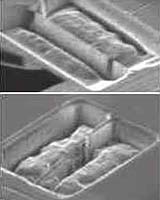
Houston TX (SPX) Oct 06, 2004 Storing the entire Library of Congress on a Palm Pilot or putting 1,000 movies on a two-inch disk may sound like incredibly futuristic goals, but University of Houston engineers are working swiftly toward making them a reality. These remarkable achievements could become feasible if researchers in UH's Cullen College of Engineering are successful in their bid to create the first nanopatterned medium recording (N-PMR) at the scale of one terabyte per square inch and explore the physical limits of magnetic data storage in units only four nanometers in size. Dmitri Litvinov, associate professor of electrical engineering at UH, is the principal investigator of a new research project that recently received funding of $1.1 million from the National Science Foundation. The project could enable the multibillion-dollar magnetic data storage industry to continue its record-setting growth rate for the next 10 to 15 years, said Litvinov, who is working closely with co-principal investigator Jack Wolfe, professor of electrical engineering at UH. Wolfe's recent innovations in atom beam lithography will provide much of the nanoscale precision needed for the project. "If we can make this work, this could be something really big for the data storage industry," Litvinov said. "The data density of magnetic hard drives has doubled every year for the past five years. But that impressive growth rate is now threatened because they're running out of options. They're running into some fundamental limits. Our system will allow them to extend this limit by a factor of 10 � maybe more." This fundamental limit is called the superparamagnetic limit, a predicament that will bring the industry's impressive growth rate to halt by as soon as 2007, according to Litvinov. The limit has to do with the relationship between the density of each crystallite and the magnetic and thermal energy necessary to read and write onto the medium. Currently, there are only two options for meeting the challenge of the superparamagnetic limit. One is thermally assisted recording that would be extremely complicated and expensive. N-PMR, the technique Litvinov and his colleagues are developing, is the other. "The big difference between current practices and what we are proposing is we want to record on a single crystallite," Litvinov says. "Right now, we record on 50 to 100 crystallites, because you need that many to have a high signal-to-noise ratio. You suppress noise by averaging many of them. Now if we could design things so that each crystallite is located in a specific place � in a lithographically defined place � then we can record on individual crystallites." As the project moves forward over the next four years, the engineers plan to extend the technology to the four nanometer limit. Currently, the theoretical limit of this new technology ranges from one to two nanometers, only one order of magnitude above the atomic level. Corporate partners with testing and other aspects of the project include Seagate Technologies, Molecular Imprints, LBNL and Euxine Technologies. Another key to the success of the project will be the work of UH collaborator T. Randall Lee, professor of chemistry and chemical engineering, who hopes to reach down to the 10 nanometer scale. When the nanoparticles arrange themselves the way Lee wants them to, they will form a mask for use in lithography. "The trick is getting the nanoparticles prepared in a fashion where they're all the same size and shape and then getting them coated with the appropriate material so that you can get them to assemble in a regular pattern," Lee said. "We are going to focus on ways to do that extremely well, using methods at the forefront of technology. We bring expertise in nanoparticle synthesis and coatings technology. For 10 years now, our group has been working in self-assembled thin films. We know how to make these coatings so that we can tailor the properties very specifically. The challenge is to avoid defects." In addition to Wolfe and Lee, Litvinov's co-principal investigators include Dieter Weller, executive director of media research at Seagate Technologies, and C. Grant Wilson, engineering professor at the University of Texas at Austin. Community Email This Article Comment On This Article Related Links University of Houston SpaceDaily Search SpaceDaily Subscribe To SpaceDaily Express Nano Technology News From SpaceMart.com Computer Chip Architecture, Technology and Manufacture
 Water, Water Everywhere Nano
 New York (UPI) Mar 18, 2005
One of the single biggest applications of nanotechnology could be solving the global shortage of pure water, experts told UPI's Nano World. |
|
|

| The content herein, unless otherwise known to be public domain, are Copyright 1995-2006 - SpaceDaily.AFP and UPI Wire Stories are copyright Agence France-Presse and United Press International. ESA PortalReports are copyright European Space Agency. All NASA sourced material is public domain. Additionalcopyrights may apply in whole or part to other bona fide parties. Advertising does not imply endorsement,agreement or approval of any opinions, statements or information provided by SpaceDaily on any Web page published or hosted by SpaceDaily. Privacy Statement |