|
 |
 |
 |
 |
 |
 |
 |
 |

 |
Nanodiamonds Help Replace Toxic Chromium Coatings
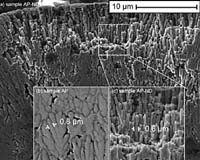
Boca Raton FL (SPX) Nov 27, 2006 Drexel University and NanoBlox researchers have shown that the mechanical characteristics of electroless nickel-boride coatings deposited on steel can be significantly improved upon the addition of small amounts of nanosized diamond particles into deposition baths. In an article, "Nanoindentation Study of the Effect of Nanodiamond Additives on Electroless Deposition Nickel-Boride Coating" and published on the Journal of Materials Online the researchers shed light on the effects of nanodiamond additives on coating properties. Until recently, chromium coatings were in widespread use due to their high mechanical properties, corrosion resistance and appealing looks. There is a strong need to replace chromium in the majority of its applications because of environmental issues. Nickel-based coatings are expected to replace chromium ones within a few years. Nickel-boride coatings have been shown to act particularly well. When compared to chromium coatings, however, they have decreased mechanical properties and wear resistance due to a highly developed columnar structure. It was found recently that minute amounts of nanosized diamond added to deposition baths increase hardness and tribological properties of nickel-based coatings by a factor of 2 to 3. Nanodiamond powder is produced in large quantities at relatively low prices by detonating old explosives in a closed chamber. "Very narrow particle size distribution, large accessible surface and a variety of surface functional groups are among unique properties of this exciting material," said Dr. Yury Gogotsi, professor of materials engineering at Drexel University and director of the A.J. Drexel Nanotechnology Institute, which coordinates and develops efforts in nanoscale science and engineering at the University. "The diameter of primary particles is 5 nanometers (10,000 times smaller than the diameter of human hair). But to fully employ these features, the as-received material should be purified first and its surface should be tailored for particular applications." In the past year, Gogotsi's research team has developed techniques for the purification of nanodiamond by selective oxidation in air and controllable conversion of a variety of functionalities at the surface of nanodiamond into a uniform coverage. That method was published in the Journal of the American Chemical Society (Vol. 128, 2006, pages 11,635 to 11,642) and is in use by NanoBlox. "Purified nanodiamond, having superior mechanical and optical properties, high thermal and low electrical conductivity and a tailored surface can be used in many areas ranging from coatings and lubricants to composites and biomedical applications," said Dr. Vadym Mochalin, a post-doctoral researcher in Gogotsi's group who leads the joint nanodiamond project between Drexel and NanoBlox. Drexel researchers found that in the process of electroless deposition of coatings, nanodiamond is not incorporated into it in any significant quantities. That explains why nanodiamond is almost not consumed in the process of deposition, so being added to the bath once it works for many months. Still, it significantly changes the structure of the coating. Particularly columnar structure and grain size are decreased upon the addition of nanodiamond. Those factors are mainly responsible for the increased hardness, corrosion resistance and performance of the coating. In contrast to heat-treatment, which is used to harden the as-plated coatings, nanodiamond additives provide the same improvement in hardness but do not increase the grain size. The ductility of the coating remains unchanged. Clarification of the role of nanodiamond in the process of electroless NiB deposition achieved in this work will have an impact on further development of chromium-coatings replacement as well as the development of environmentally friendly coating processes for numerous applications. Community Email This Article Comment On This Article Related Links Drexel University NanoBlox Full Article Text Nano Technology News From SpaceMart.com Computer Chip Architecture, Technology and Manufacture
 On The Cutting Edge: Carbon Nanotube Cutlery
 Boulder CO (SPX) Nov 23, 2006
Researchers at the National Institute of Standards and Technology (NIST) and the University of Colorado at Boulder (CU) have designed a carbon nanotube knife that, in theory, would work like a tight-wire cheese slicer. |
|
|

| The content herein, unless otherwise known to be public domain, are Copyright 1995-2006 - SpaceDaily.AFP and UPI Wire Stories are copyright Agence France-Presse and United Press International. ESA PortalReports are copyright European Space Agency. All NASA sourced material is public domain. Additionalcopyrights may apply in whole or part to other bona fide parties. Advertising does not imply endorsement,agreement or approval of any opinions, statements or information provided by SpaceDaily on any Web page published or hosted by SpaceDaily. Privacy Statement |