|
 |
 |
 |
 |
 |
 |
 |
 |

 |
Nano World: Nanotech Could Power Computers
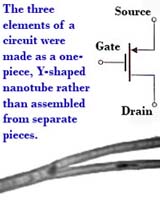
New York (UPI) Aug 16, 2005 Scientists for the first time have created a transistor made from carbon nanotubes alone, a development that could lead to more powerful computers than current versions employing conventional silicon transistors, experts told UPI's Nano World. "The applications would be an entirely new class of nanoelectronic devices," said lead researcher Prabhakar Bandaru, a materials scientist at the University of California, San Diego. Modern computers work by encoding data as a series of ones and zeros. This code is conveyed via transistors, which are minute switches that can either be flicked on or off to represent a one or a zero. The dramatic growth in the speed of electronics over time is due in large part to the steady drop in the size of transistors, which allows more and more to be crammed closer together. The problem: Shrinking the features of conventional electronics past 10 nanometers -- where distances are in the range of atoms -- is virtually impossible, because the electrons start to jump back and forth randomly. Based on Moore's law -- the chip industry's observed ability to double transistor density roughly every two years -- the 10-nanometer limit should arrive in roughly 15 years. Scientists have experimented with carbon nanotubes in transistors for the last 10 years. Prior attempts employed the nanotubes as channels for electrical current, with a separate component known as a gate made of silica and silicon that switched the current on and off. Bandaru and colleagues instead developed a carbon-nanotube transistor with the gate built into the device. They started with straight multi-walled nanotubes and mixed in iron-titanium particles that catalyzed the growth of additional tubes from the originals, much like branches from a tree.

|