|
 |
 |
 |
 |
 |
 |
 |
 |

 |
Nano World: Nano Diamond Tips As Pens
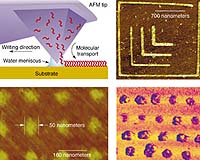
New York (UPI) Aug 29, 2005 Diamond slivers only nanometers wide soon could help serve as pens that help print advanced circuitry and DNA sequencing devices, experts told UPI's Nano World. Researchers for the last two decades have employed atomic-force microscopes to act as hands as well as eyes on the atomic level. Invented by IBM physicists Gerd Binnig and Christoph Gerber with Stanford University electrical engineer Calvin Quate in 1986, atomic-force microscopes run extraordinarily sharp cantilevers up and down surfaces and scan with three-dimensional details, much as a blind person uses his or her fingers to read bumps on a page of Braille. In 1999 a new way to use atomic-force microscopes called dip-pen lithography emerged that nanotechnologists worldwide have said could revolutionize electronics and genetics. Dip-pen lithography dips atomic-force microscope cantilevers into any kind of ink scientists can devise - for instance, semiconductor fluids or DNA - and then employs the probes as pens to write onto surfaces with nanometer precision. If dip-pen lithography can be scaled up, "it could steamroll everything else out there" in the field of semiconductor manufacturing, said Nathan Tinker, cofounder and executive vice president of the NanoBusiness Alliance in New York City. A common problem atomic-force microscopes face is how their cantilever tips break down as they run over surfaces. Researchers at Northwestern University in Evanston, Ill., and Argonne National Laboratory, also in Illinois, have invented probes made of what they call ultra nanocrystalline diamond. They are "superior to anything available commercially," said lead researcher Horacio Espinosa, an engineer at Northwestern. Until now, commercially available atomic-force microscope tips either were glued onto the cantilever or made by coating a 10- to 20-nanometer-wide silicon tip with synthetic diamond. Gluing on diamond tips is a very slow approach that is extraordinarily difficult to scale up, and diamond coatings on silicon tips typically run 70 nanometers to 100 nanometers thick, reducing the probe's sharpness. The researchers found ultra nanocrystalline diamond easy to mold and shape into cantilevers with 30-nanometer-wide tips. The scientists first deposited diamond into pyramid-shaped silicon molds to form the tip, then etched the rest of the cantilever using conventional micro-fabrication techniques. "This technology offers tremendous potential for large-scale production," Espinosa said. "The demonstrated low wear and writing capability of ultra nanocrystalline tips with chemical inks is very promising." "We will use these tips to achieve a variety of nanoscale measurements, including conductivity measurements of neurons to examine synapses and signal mechanisms," he added. "They have done a great job," micro- and nanotechnology researcher Chang Liu at the University of Illinois at Urbana-Champaign told Nano World. He suggested the research could perhaps lead to "a probe that will never have to be replaced" and expected it to reach the market in six to 12 months. Northwestern University has filed a patent on this device and is seeking a licensing partner to commercialize this advance. Espinosa and colleagues reported their invention in the Aug. 9 issue of the journal Small. Charles Choi covers research and technology for UPI. Community Email This Article Comment On This Article Related Links SpaceDaily Search SpaceDaily Subscribe To SpaceDaily Express Nano Technology News From SpaceMart.com Computer Chip Architecture, Technology and Manufacture
 Prof Develops Cancer Nanobomb
 Newark DE (SPX) Oct 14, 2005
University of Delaware researchers are opening a new front in the war on cancer, bringing to bear new nanotechnologies for cancer detection and treatment and introducing a unique nanobomb that can literally blow up breast cancer tumors. |
|
|

| The content herein, unless otherwise known to be public domain, are Copyright 1995-2006 - SpaceDaily.AFP and UPI Wire Stories are copyright Agence France-Presse and United Press International. ESA PortalReports are copyright European Space Agency. All NASA sourced material is public domain. Additionalcopyrights may apply in whole or part to other bona fide parties. Advertising does not imply endorsement,agreement or approval of any opinions, statements or information provided by SpaceDaily on any Web page published or hosted by SpaceDaily. Privacy Statement |