|
 |
 |
 |
 |
 |
 |
 |
 |

 |
Nano World: A Nano DNA-Delivery System
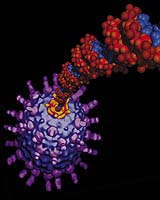
New York (UPI) July 26, 2005 Scientists have used silica nanoparticles loaded with DNA to deliver genes safely into mouse brains, a technique that could lead to gene therapies able to repair cells more safely and effectively than current methods, which rely on viral vectors. Gene therapy seeks to transport genes into the body to treat disorders such as sickle cell anemia, cystic fibrosis, muscular dystrophy and hemophilia by supplementing unhealthy mutant genes with therapeutic proteins. With conventional viral-vector gene therapy, the body's immune system often reacts and seeks to destroy the transported genes, rendering them ineffective. Moreover, the viral carriers may damage chromosomes when they insert genes. Though the therapy has been used successfully to treat a condition called X-linked severe combined immunodeficiency and has restored the immune systems of at least 17 children, three children receiving the therapy developed leukemia. Paras Prasad, a physical chemist and executive director of the University of Buffalo Institute for Lasers, Photonics and Biophotonics in New York, has created silica particles roughly 30 nanometers in diameter as non-viral gene-therapy delivery mechanisms. The synthesis of these nanoparticles, led by University of Buffalo chemist Dhruba Bharali, involves coating their surfaces with organic molecules that bind to genetic payloads, protecting the delicate DNA from enzymatic digestion. "Non-viral vectors are attractive in terms of low cost, non-infectivity, absence of host response, good patient compliance, well-defined characteristics and possibility of repeated clinical administration," Prasad told UPI's Nano World. Prasad, along with microbiologist Jim Bergey, neuroscientist Michal Stachowiak and colleagues, experimented on mouse brains with nanoparticles bearing genes for a fluorescent green protein and a molecule bearing the complicated name, nucleus-targeting fibroblast growth factor receptor type 1. This molecule is linked to the development of brain cells, and controlling their proliferation could help treat damage from stroke, Parkinson's disease and Alzheimer's disease. After injecting silica nanoparticles into the substantia nigra pars compacta, or SNc -- a brain region that degenerates in Parkinson's disease -- the resulting green fluorescent brain cells revealed that the nanoparticles had delivered their payloads. The nanoparticles affected more than one-third of the targeted cells -- a result equal to or greater than the most effective existing viral delivery systems, Prasad said. No mice showed adverse side effects one month after the injections. The findings appear online this week in the Proceedings of the National Academy of Sciences. "This is an important and exciting first demonstration that silica nanoparticles, or other materials with properties similar to silica nanoparticles, can be used for gene therapy -- maybe even for gene therapy of serious human diseases such as Parkinson's," Mark Saltzman, a biomedical engineer at Yale University, told Nano World. Other nanoparticles made of biodegradable polymers also could serve in gene therapy, he added. Prasad said his team added fluorescent components to help track the nanoparticles, as well as the proteins that latch onto specific cells of interest. He cautioned that the long-term effects of these nanoparticles need further study before any therapeutic use could be attempted. "I would say that it is possible, with enough money and talented people, to develop this technology for use in cancer-related applications within five years or so," Saltzman said. "Application for Parkinson's disease is likely to take much, much longer -- say 15 years." Charles Choi covers research and technology for UPI Science News. Community Email This Article Comment On This Article Related Links SpaceDaily Search SpaceDaily Subscribe To SpaceDaily Express Nano Technology News From SpaceMart.com Computer Chip Architecture, Technology and Manufacture
 Prof Develops Cancer Nanobomb
 Newark DE (SPX) Oct 14, 2005
University of Delaware researchers are opening a new front in the war on cancer, bringing to bear new nanotechnologies for cancer detection and treatment and introducing a unique nanobomb that can literally blow up breast cancer tumors. |
|
|

| The content herein, unless otherwise known to be public domain, are Copyright 1995-2006 - SpaceDaily.AFP and UPI Wire Stories are copyright Agence France-Presse and United Press International. ESA PortalReports are copyright European Space Agency. All NASA sourced material is public domain. Additionalcopyrights may apply in whole or part to other bona fide parties. Advertising does not imply endorsement,agreement or approval of any opinions, statements or information provided by SpaceDaily on any Web page published or hosted by SpaceDaily. Privacy Statement |