|
 |
 |
 |
 |
 |
 |
 |
 |

 |
Nano Particles Find Some Stability In Orbit
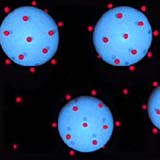
Washington - August 6, 2001 A NASA-funded study in materials science has yielded a discovery that may significantly change the way electronics, paint, cosmetics and pharmaceutical industries develop products. Researchers discovered a new approach for suspending fine particles in fluids. Such collections of particles, called colloids or colloidal suspensions, may help researchers better understand how to manipulate small particle assemblies found in fluids such as water or organic solvents (e.g., ethanol). According to a paper co-authored by a NASA researcher at the University of Illinois at Urbana-Champaign, which will appear in today's issue of the Proceedings of the National Academy of Sciences, the authors have devised a process that stabilizes particles in fluids to prevent them from otherwise organizing themselves or coagulating into a disordered gel- like structure. The authors have named this approach "nanoparticle haloing." "Paint is an example of a fluid that contains suspended colloidal particles. If such particles become unstable, they clump together causing the paint to thicken substantially. This limits the product's shelf life. By using the nanoparticle haloing approach, we can control the behavior and structure of materials in fluids," said Dr. Jennifer Lewis, co-author, NASA researcher and professor at the University of Illinois. Lewis and her colleagues conducted the research under a grant from NASA's Office of Biological and Physical Research, Washington, DC. The research program offers investigators the opportunity to use a microgravity or low-gravity environment to enhance understanding of fundamental physical and chemical processes associated with materials science. "NASA scientists are using microgravity to examine the properties and structures of materials and the role processing plays in creating the materials. By subtracting gravity from the equation, we are better able to see what is happening as a material is produced," said Dr. Kathie Olsen, Acting Associate Administrator for Biological and Physical Research at NASA Headquarters. By tailoring the interactions between particles, the researchers were able to engineer the desired degree of colloidal stability into the mixture. "That means we can create designer colloidal fluids, gels and even crystals," Lewis said. "This designer capability will assist us in developing improved materials such as photonics." Photonics are materials that control the flow of light. For example, Lewis has teamed with co-author Paul Braun, another professor of materials science and engineering at the University of Illinois, to explore the use of these nanoparticle-stabilized colloidal microsphere mixtures in assembling robust periodic templates for photonic band gap materials. The researchers recently were awarded funding by the National Science Foundation to pursue such efforts. Lewis and her students are also studying the structure and flow behavior of colloidal fluids and gels assembled from these microsphere-nanoparticle mixtures. By simply varying composition, the researchers can produce systems whose properties vary dramatically. Such studies provide the foundation of ongoing efforts in the area of colloidal processing of electrical ceramics. In addition to Lewis and Braun, the research team included University of Illinois doctoral students Valeria Tohver and James Smay, from Lewis' group, and graduate student Alan Braem from Carnegie Mellon University, Pittsburgh. Community Email This Article Comment On This Article Related Links NASA's Biological and Physical Research Program Colloids at Illinois SpaceDaily Search SpaceDaily Subscribe To SpaceDaily Express Space
 Satellite Launch To Boost DTH In India
 Calcutta, India (SPX) Dec 28, 2005
The successful launch Thursday of India's heaviest satellite from spaceport of Kourou in French Guyana may have boosted the country's space research efforts to yet another level, but it has also lifted the spirits of at least three Direct-To-Home televisions broadcasters, one of which has been waiting for years to launch its services in India. |
|
|

|
|
|
|
|
|
|
|
|
|
|
|
| The content herein, unless otherwise known to be public domain, are Copyright 1995-2006 - SpaceDaily.AFP and UPI Wire Stories are copyright Agence France-Presse and United Press International. ESA PortalReports are copyright European Space Agency. All NASA sourced material is public domain. Additionalcopyrights may apply in whole or part to other bona fide parties. Advertising does not imply endorsement,agreement or approval of any opinions, statements or information provided by SpaceDaily on any Web page published or hosted by SpaceDaily. Privacy Statement |