|
 |
 |
 |
 |
 |
 |
 |
 |

 |
NRL Researchers Investigate Early Solar System
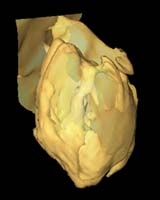
Washington DC (SPX) Aug 17, 2006 Scientists at the Naval Research Laboratory are part of an international research team that is studying minerals formed during the early history of the solar system. Their goal is to learn more about the chemical and physical processes that occurred during the formation of the solar system. Their research was published in the May 2006 issue of Meteoritics and Planetary Science where a figure from the paper was selected as the cover image. The researchers studied serpentine minerals in a group of primitive meteorites called CM carbonaceous chondrites. The CM carbonaceous chondrites formed over 4.5 billion years ago in the solar nebula, the cloud of gas and dust from which our sun and planets formed. Using a transmission electron microscope (TEM), the researchers imaged the three-dimensional structure of the serpentines and analyzed their compositions. A TEM is capable of imaging the atomic structure of a material, and the research team needed its resolving power to analyze the serpentines, which are small, on the order of 90 nanometers (1 nanometer = 0.000000001 meter). Serpentines form by chemical reaction of anhydrous silicates (minerals that do not contain hydrogen) and water. The research team's findings reveal that the formation of these minerals occurred under oxygen-rich conditions, and suggest that the parent asteroids of the meteorites contained active hydrothermal systems that were capable of driving chemical reactions. Such reactions were likely similar to those that occur on Earth, but transpired over 4.5 billion years ago in space. Thomas Zega, who is the lead author on the paper, and Rhonda Stroud are researchers in NRL's Materials Science and Technology Division. The research team also includes members from Arizona State University, Eotvos L. University in Budapest, Hungary, and Utrecht University in The Netherlands. Community Email This Article Comment On This Article Related Links Naval Research Laboratory Stellar Chemistry, The Universe And All Within It Beyond Sol Stellar Chemistry, The Universe And All Within It
 Hidden Milky Way Deuterium Found
 Baltimore MD (SPX) Aug 16, 2006
Scientists using NASA's Johns Hopkins University-operated Far Ultraviolet Spectroscopic Explorer satellite have learned that far more "heavy" hydrogen remains in our Milky Way galaxy than expected, a finding that could radically alter theories about star and galaxy formation. |
|
|

| The content herein, unless otherwise known to be public domain, are Copyright 1995-2006 - SpaceDaily.AFP and UPI Wire Stories are copyright Agence France-Presse and United Press International. ESA PortalReports are copyright European Space Agency. All NASA sourced material is public domain. Additionalcopyrights may apply in whole or part to other bona fide parties. Advertising does not imply endorsement,agreement or approval of any opinions, statements or information provided by SpaceDaily on any Web page published or hosted by SpaceDaily. Privacy Statement |