|
 |
 |
 |
 |
 |
 |
 |
 |

 |
NJIT Math Professor Helps Navy Detect Subs; Explains Global Warming
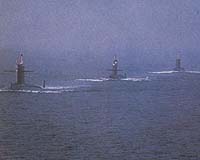
Newark NJ (SPX) Apr 06, 2005 The world's oceans, and mathematics, have a lot to say to Eliza Michalopoulou, PhD, associate professor in the department of mathematics at New Jersey Institute of Technology (NJIT). Her work illustrates another of the many ways in which mathematics defends the nation. As a mathematician, Michalopoulou devises algorithms to help U.S. Navy engineers detect submarines in shallow water. From her underwater (also known as acoustical) research, Michalopoulou can determine the location of submarines and whales, the earth's changing climate, even environmental contamination. To do this, Michalopoulou studies sound mathematically as it travels from an underwater source to a detector and processing equipment. Grants totaling upwards of $1million from the Office of Naval Research (ONR) have supported her work since 1997. The multifaceted potential of Michalopoulou's research arises from ONR's interest in better techniques for detecting submarines in water up to several hundred meters deep. Typically, these are coastal environments that tend to be especially complex when it comes to identifying the source of a sound and pinpointing its location. The challenge is compounded by submarines which may penetrate the nation's territorial waters that are becoming much quieter, necessitating improved technology for detection and localization. As Michalopoulou explains, many factors influence the propagation of sound in such environments. Among them are water temperature, the number of times sound waves bounce between the surface of the ocean and the earth below, the slope of the ocean floor and its subsurface geologic profile. It's also necessary to factor in the identifying characteristics of a sound source - sea life or submarine - and the noises of civilization emanating from shore and nearby surface vessels. The raw material of Michalopoulou's oceanic insights is a growing body of data from sources, most notably ONR colleagues, to which she applies analytical techniques such as matched field processing and inversion analysis. These and other techniques help to address the problems of oceanic sound propagation and localization, including the influence of geologic features beneath the ocean's floor that must be acoustically imaged. The end products of her research are special algorithms, or precise mathematical tools, that may eventually be applied in next-generation systems for protecting the shores of the U.S. against unauthorized underwater incursions. While national defense is a primary focus of Michalopoulou's ONR-funded research, her efforts have very significant implications for other fields. One is the study of climatic trends and the continuing international dialogue on global warming. Detecting and localizing sound from any oceanic source requires a comprehensive understanding of the medium through which the sound travels. This includes the influence of temperature on sound propagation. In general, the warmer the water, the faster sound will travel between a source and a detector. Accordingly, investigating oceanic sound propagation relative to historic seasonal variations for antisubmarine research also promises to yield insights into climate change - whether due to natural cycles or human activity. Sound propagation can be affected by the ocean's chemical composition as well. Therefore, in addition to climatic information, acoustic analysis can signal changes in the composition of water in a particular area, possibly due to the presence of harmful contaminants. In recent years, Michalopoulou said, mathematical biology has emerged as a field where cooperative engagement means not just interdepartmental work at NJIT. It encompasses research in which members of the math department are contributing their insights to joint efforts with institutions such as the University of Medicine and Dentistry of New Jersey. Areas of inquiry have ranged from basic research involving neuroscience to determining the optimal pattern for wound sutures. Community Email This Article Comment On This Article Related Links NJIT SpaceDaily Search SpaceDaily Subscribe To SpaceDaily Express Military Space News at SpaceWar.com
 Space Group To Activate New Unit
 Colorado Springs CO (SPX) Jan 6, 2006
Air Force Reserve Command's 310th Space Group will travel deeper into the space program when it activates a new unit Jan. 7. Headquarters Reserve National Security Space Institute will be a Reserve associate unit to the National Security Space Institute in Colorado Springs, Colo. The institute is the Department of Defense's focal point for providing education about space power in joint warfighting. |
|
|

| The content herein, unless otherwise known to be public domain, are Copyright 1995-2006 - SpaceDaily.AFP and UPI Wire Stories are copyright Agence France-Presse and United Press International. ESA PortalReports are copyright European Space Agency. All NASA sourced material is public domain. Additionalcopyrights may apply in whole or part to other bona fide parties. Advertising does not imply endorsement,agreement or approval of any opinions, statements or information provided by SpaceDaily on any Web page published or hosted by SpaceDaily. Privacy Statement |