|
 |
 |
 |
 |
 |
 |
 |
 |

 |
NIST Atomic Fountain Clock Gets Much Better With Time
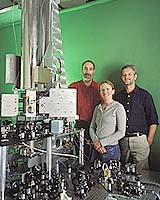
Gaithersburg MD (SPX) Sep 28, 2005 The world's best clock, NIST-F1, has been improved over the past few years and now measures time and frequency more than twice as accurately as it did in 1999 when first used as a national standard, physicists at the National Institute of Standards and Technology (NIST) report. The improved version of NIST-F1 would neither gain nor lose one second in 60 million years, according to a paper published online Sept. 13 by the journal Metrologia. NIST-F1 uses a fountain-like movement of cesium atoms to determine the length of the second. The clock measures the natural oscillations of the atoms to produce more than 9 billion "ticks" per second. These results then contribute to the international group of atomic clocks that define the official world time. NIST-F1 has been formally evaluated 15 times since 1999; in its record performance, it measured the second with an uncertainty of 0.53 � 10-15 The improved accuracy is due largely to three factors, according to Tom Parker, leader of the NIST atomic standards research group. First, better lasers, software and other components have made the entire NIST-F1 system much more reliable and able to operate for longer periods of time. Second, the atoms in the cesium vapor are now spread out over a much larger volume of space, reducing the frequency shifts caused by interactions among the atoms. (The formerly round cloud of atoms is now shaped like a short cigar.) Third, scientists are now better able to control magnetic fields within the clock and quantify the corrections needed to compensate for their effects on the atoms. Improved time and frequency standards have many applications. For instance, ultraprecise clocks can be used to improve synchronization in precision navigation and positioning systems, telecommunications networks, and wireless and deep-space communications. Better frequency standards can be used to improve probes of magnetic and gravitational fields for security and medical applications, and to measure whether "fundamental constants" used in scientific research might be varying over time - a question that has enormous implications for understanding the origins and ultimate fate of the universe. * T.P. Heavner, S.R. Jefferts, E.A. Donley, J.H. Shirley, T.E. Parker. 2005. NIST-F1: Recent improvements and accuracy evaluations. Metrologia (October 2005). Posted online Sept. 13. Community Email This Article Comment On This Article Related Links SpaceDaily Search SpaceDaily Subscribe To SpaceDaily Express Understanding Time and Space
 Unified Physics Theory Explains Animals Running Flying And Swimming
 Durham NC (SPX) Jan 05, 2006
A single unifying physics theory can essentially describe how animals of every ilk, from flying insects to fish, get around, researchers at Duke University's Pratt School of Engineering and Pennsylvania State University have found. The team reports that all animals bear the same stamp of physics in their design. |
|
|

| The content herein, unless otherwise known to be public domain, are Copyright 1995-2006 - SpaceDaily.AFP and UPI Wire Stories are copyright Agence France-Presse and United Press International. ESA PortalReports are copyright European Space Agency. All NASA sourced material is public domain. Additionalcopyrights may apply in whole or part to other bona fide parties. Advertising does not imply endorsement,agreement or approval of any opinions, statements or information provided by SpaceDaily on any Web page published or hosted by SpaceDaily. Privacy Statement |