|
 |
 |
 |
 |
 |
 |
 |
 |

 |
NEAR Team Set For New Phase
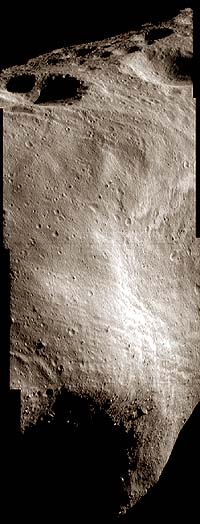
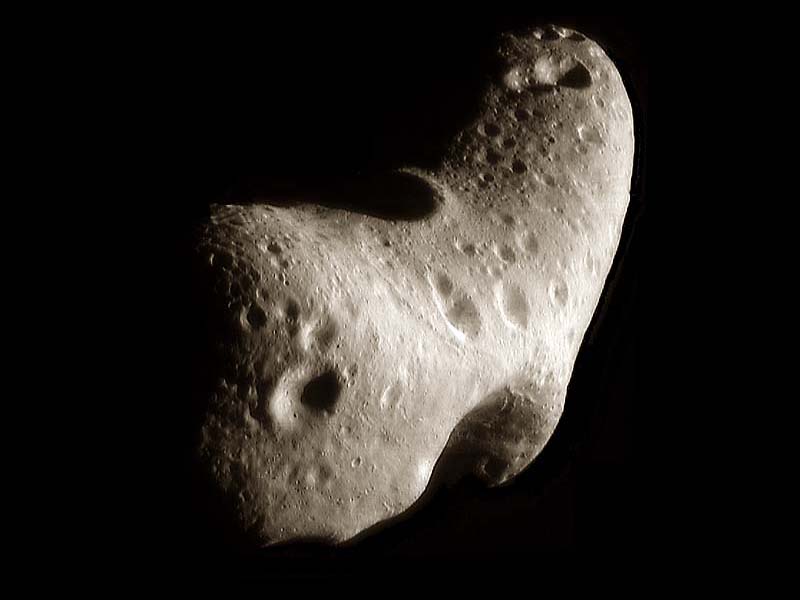
Laurel - June 19, 2000 - Laurel - June 19, 2000 - During the past week, NEAR Shoemaker remained in Operational Mode with Flight Computer #1 and Attitude Interface Unit #2 in control of spacecraft attitude. Except for the Near-Infrared Spectrometer (NIS), the spacecraft instrument suite remained "ON" and operational this week. NEAR Shoemaker is presently in a nominal 50 km circular orbit around Eros. The spacecraft entered this orbit April 30, 2000 at 16:15 UTC when Orbit Correction Maneuver 6 (OCM 6) was executed. According to the current long term trajectory plan, NEAR Shoemaker will remain in this orbit conducting Science observations until July 7, 2000 at 18:00 UTC when Orbit Correction Maneuver 7 (OCM 7) will initiate the 50 km x 35 km transfer orbit. Since the next planned OCM is not scheduled until July 7, weekly Momentum Correction Maneuvers (MCM) are required to manage spacecraft system momentum. Beginning May 10, these maneuvers are scheduled every Wednesday until June 28. The sixth MCM of this period, MCM 8, was successfully executed this past Wednesday, June 14, at 16:00 UTC. The achieved momentum was well within operational tolerances, and the imparted delta V was minor. Revised NLR flight application software is scheduled to be loaded to the spacecraft later this month. In preparation for this event, procedures to load, dump, and verify the software, have been written and successfully brassboard tested. Mission Operations testing of the revised flight application has begun and should be completed within the week. Since restoration to operational mode, the XGRS has been performing well. The source of the anomaly, which set the instrument Disaster Code and autonomously turned the XGRS "OFF", has been isolated and a fix identified. The fix has been loaded to the brassboard and is currently being tested. Preliminary results indicate the repair is successful. The NIS instrument remains disabled. A brief one-minute NIS survival test was executed this past Monday (DOY 157) to evaluate the health of the instrument. Unfortunately, this test indicated the NIS state is the same as when disabled several weeks ago. Currently, there are no future NIS turn "ON" plans. Except for the NIS, science activities conducted this week included Eros observations by the full instrument suite: MSI, MAG, XGRS and NLR. Please consult science timelines for more details.
Upcoming Spacecraft Activities:
|
Laurel - June 19, 2000 - While it slowly orbits asteroid Eros, NEAR Shoemaker wages somewhat of a shoving match with the sun. Solar radiation constantly torques the small satellite -- which fights this force with four internal spinning wheels that act like gyroscopes, keeping the spacecraft's solar panels and scientific instruments pointed in the right direction. "But when the amount of energy in the wheels starts to get too high, we have to dump that momentum," says Bob Nelson, a member of the NEAR mission operations team at the Applied Physics Laboratory. "Otherwise, after about 10 days, the wheels would start to spin so fast that if we didn't do something the spacecraft would start to tumble," said Nelson. On June 14, the NEAR team conducted the latest of many correction maneuvers designed to decrease momentum buildup in the wheels. On commands from NEAR mission operations, the spacecraft fires several short bursts from its small thrusters. The thrusts hold the spacecraft in place against the sun's influence while the wheels shed excess momentum and adjust their spin rates. From its current orbit 31 miles (50 kilometers) from Eros, NEAR Shoemaker will perform two more "momentum dumps" before moving toward a 22-mile (35-kilometer) orbit on July 7. The orbit correction maneuvers that adjust the craft's distance from Eros also reduce the excess momentum in the reaction wheels.
|
Community
Email This Article
Comment On This Article
Related Links
Space
 Memory Foam Mattress Review |
Newsletters :: SpaceDaily :: SpaceWar :: TerraDaily :: Energy Daily XML Feeds :: Space News :: Earth News :: War News :: Solar Energy News |
 Satellite Launch To Boost DTH In India
 Calcutta, India (SPX) Dec 28, 2005
|
|

|
|
|
|
|
|
|
|
|
|
|
|
| The content herein, unless otherwise known to be public domain, are Copyright 1995-2006 - SpaceDaily.AFP and UPI Wire Stories are copyright Agence France-Presse and United Press International. ESA PortalReports are copyright European Space Agency. All NASA sourced material is public domain. Additionalcopyrights may apply in whole or part to other bona fide parties. Advertising does not imply endorsement,agreement or approval of any opinions, statements or information provided by SpaceDaily on any Web page published or hosted by SpaceDaily. Privacy Statement |