|
 |
 |
 |
 |
 |
 |
 |
 |

 |
NEAR Team Seeks Clues in Close Orbit
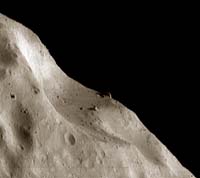
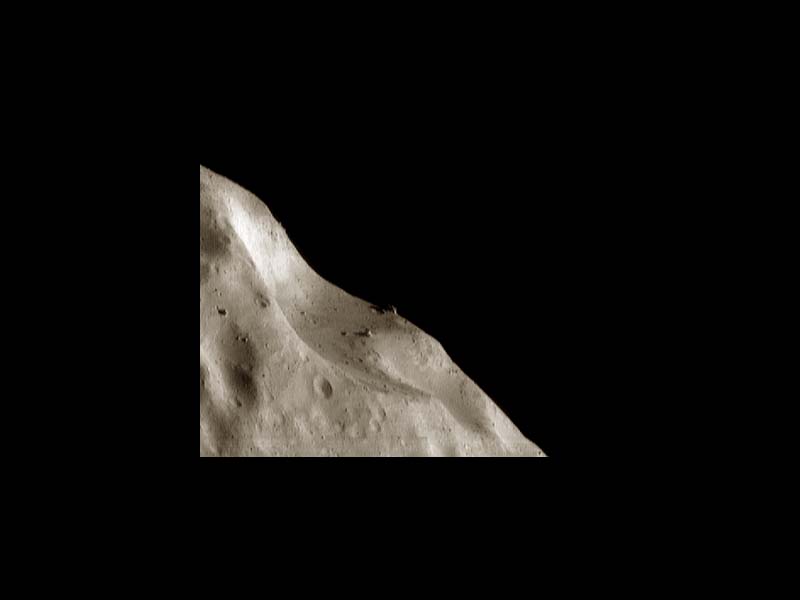
Laurel - July 25, 2000 - Boulders or big dirt piles? Still dust or shifting particles? The NEAR team hopes the high-resolution pictures NEAR Shoemaker sends back from its current 22-mile (35 kilometer) orbit around Eros can answer the range of questions they have about the asteroid's surface. "This is the closest we've ever been, giving us a more detailed view of Eros than we've ever had," says NEAR Project Scientist Andy Cheng of the Applied Physics Laboratory. "We're very interested in getting a closer look at the size and shape of the boulders, the texture of the surface, and finding out whether the regolith - the layer of dust - is moving across the surface." Since completing a four-day gravity experiment on July 17 - and gathering critical data for designing low-altitude maneuvers later in the mission - the NEAR team has shifted its attention to imaging and other scientific activities. Though 22 miles from the center of Eros, the orbit actually brings NEAR Shoemaker anywhere from 12 to 18 miles (19 to 30 kilometers) from the asteroid's surface, which is prime positioning for the X-ray/gamma-ray spectrometer to analyze Eros' elemental composition. NEAR Shoemaker could also be close enough for its magnetometer to detect a magnetic field from Eros - should the asteroid have one. "The solar wind carries its own magnetic field, which reflects the magnetic field at the surface of the sun where the wind originated," says magnetometer instrument scientist Brian Anderson of the Applied Physics Laboratory. "Because the sun rotates and because of solar magnetic activity, the solar wind magnetic field is quite variable in space. Our challenge is trying to detect a possible Eros magnetic signature against the variable background of the solar wind field." The spacecraft will keep its current position until July 24, when a short engine burn will send it back toward an orbit 31 miles (50 kilometers) from the Eros. By then, NEAR Shoemaker will have circled Eros 14 times in its current orbit.
Upcoming Spacecraft Activities:
|
Laurel - July 21, 2000 - NEAR Shoemaker successfully entered a 35 km circular orbit around the asteroid Eros last Friday, July 14 at 00:30 UTC, and continues to operate in that orbit. After entering the 35 km orbit, post burn critical opnavs were collected and recovered, and the next four days were spent sun-pointing to refine the gravitational field model. The remaining period in this orbit is allocated to XGRS for prime science data collection. During this past week, NEAR Shoemaker remained in Operational Mode with Flight Computer #1 and Attitude Interface Unit #2 in control of spacecraft attitude. Except for the Near-Infrared Spectrometer (NIS), the spacecraft instrument suite remained "ON" and operational this week. Orbit Correction Maneuver 8 (OCM 8), performed near periapse of the 35 km x 50 km transfer orbit, placed the spacecraft in a nominal 35 km circular orbit relative to the center of Eros. According to the mission plan, the spacecraft is scheduled to remain in this orbit until July 24 at 17:00 UTC. Today is currently the eighth day of 35 km orbital operations. In approximately two and a half days, Orbit Correction Maneuver 9 (OCM 9) will terminate this first sojourn to 35 km by initiating a 35 km x 50 km transfer orbit.
Except for the NIS, science activities conducted this week included Eros observations by the full instrument suite: MSI, MAG, XGRS and NLR. Please consult science timelines for more details. |
Community
Email This Article
Comment On This Article
Related Links
Space
 Memory Foam Mattress Review |
Newsletters :: SpaceDaily :: SpaceWar :: TerraDaily :: Energy Daily XML Feeds :: Space News :: Earth News :: War News :: Solar Energy News |
 Satellite Launch To Boost DTH In India
 Calcutta, India (SPX) Dec 28, 2005
|
|

|
|
|
|
|
|
|
|
|
|
|
|
| The content herein, unless otherwise known to be public domain, are Copyright 1995-2006 - SpaceDaily.AFP and UPI Wire Stories are copyright Agence France-Presse and United Press International. ESA PortalReports are copyright European Space Agency. All NASA sourced material is public domain. Additionalcopyrights may apply in whole or part to other bona fide parties. Advertising does not imply endorsement,agreement or approval of any opinions, statements or information provided by SpaceDaily on any Web page published or hosted by SpaceDaily. Privacy Statement |