|
 |
 |
 |
 |
 |
 |
 |
 |

 |
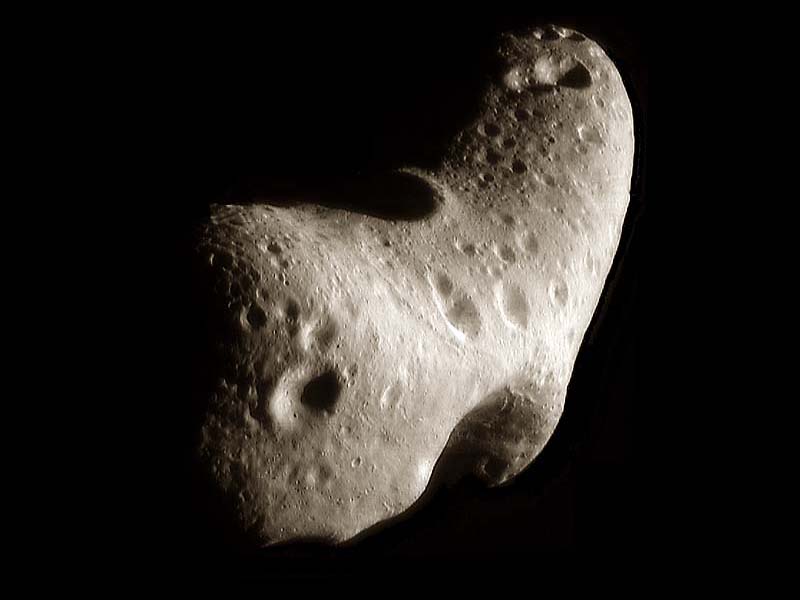
NEAR Shoemaker Has Eros Covered
Laurel - July 1, 2000 - To NEAR Shoemaker's digital camera it was merely another sequence of images. But the photos of Eros' south pole snapped in the early hours of June 27 will give NEAR team members the last pieces of a global puzzle, covering the only ground on Eros they haven't seen since the satellite began orbiting the asteroid on Feb. 14. "We're filling in the last little gaps," says Louise Prockter, a member of the NEAR imaging team at the Applied Physics Laboratory. "Once we process those images, we will have everything we need for a global mosaic of Eros." It's autumn in the asteroid's northern hemisphere, which means the sun is illuminating the southern regions that were shadowed through the first months of NEAR Shoemaker's orbit. The camera couldn't "see" the areas earlier because it needs reflected light from the surface, so most of the imaging covered the northern sections. Now that it has a overall view of Eros, the NEAR team can start to train the camera on specific details among the asteroid's craters, ridges, grooves, boulders and troughs. "Every day we see new structures," Prockter says. "We have seen an incredible variety of amazing features, and we are recognizing things we've seen on other terrestrial planets and bodies. " The NEAR team gets its closest look yet at those features on July 14, when the spacecraft begins a 10-day, nearly circular orbit just 22 miles (35 kilometers) from the asteroid's surface. NEAR Shoemaker descends from its current 31-mile (50-kilometer) vantage on July 7. The spacecraft is 74 million miles (118 million kilometers) from Earth, circling Eros at just under 7 miles an hour.
|
Washington - July 1, 2000 - It is widely recognized that comet, asteroid, and meteorite research is at a point in its history where sample return from a known geologic context is essential, and several past workshops have stressed the need for such missions. Near-Earth asteroids (NEAs) are also important as potential Earth impactors, targets for human exploration and development of space (HEDS), and resources for space stations and colonies. Several developments in the last year or so mean that it is now technically feasible to fly NEA sample return missions. The NEAR Shoemaker mission demonstrated the feasibility of orbiting and performing complex maneuvers near small asteroids. The Deep Space 1 mission validated solar electric propulsion and automatic navigation. Most important, the explosion in the rate at which NEAs are being discovered means that targets of diverse spectral classification, including some that might be extinct comets, come within range of a multiple NEA sample return mission. The Japanese MUSES-C mission, which will return samples from asteroid ML 1989, is scheduled for launch in 2002.
|
 Memory Foam Mattress Review |
Newsletters :: SpaceDaily :: SpaceWar :: TerraDaily :: Energy Daily XML Feeds :: Space News :: Earth News :: War News :: Solar Energy News |
 Satellite Launch To Boost DTH In India
 Calcutta, India (SPX) Dec 28, 2005
|
|

|
|
|
|
|
|
|
|
|
|
|
|
| The content herein, unless otherwise known to be public domain, are Copyright 1995-2006 - SpaceDaily.AFP and UPI Wire Stories are copyright Agence France-Presse and United Press International. ESA PortalReports are copyright European Space Agency. All NASA sourced material is public domain. Additionalcopyrights may apply in whole or part to other bona fide parties. Advertising does not imply endorsement,agreement or approval of any opinions, statements or information provided by SpaceDaily on any Web page published or hosted by SpaceDaily. Privacy Statement |