|
 |
 |
 |
 |
 |
 |
 |
 |

 |
NCAR Researcher Sheds Light On Solar Storms
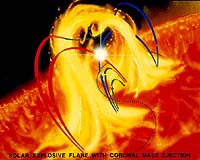
Boulder CO (SPX) May 31, 2005 New research from the National Center for Atmospheric Research (NCAR) links a particular magnetic structure on the Sun with the genesis of powerful solar storms that can buffet Earth's atmosphere. The research may enable scientists to create more accurate computer models of the solar storms, known as coronal mass ejections (CMEs), and could eventually point the way to forecasting the storms days before they occur. Sarah Gibson, a scientist at NCAR's High Altitude Observatory (HAO), presented her findings at the American Geophysical Union conference in New Orleans on Thursday. Her invited talk is in recognition of winning this year's Karen Harvey Prize. Awarded by the Solar Physics Division of the American Astronomical Society, the prize recognizes an early-career scientist who has produced exceptional solar research. CMEs are a focus of solar research because they suddenly and violently release billions of tons of matter and charged particles that escape from the Sun and speed through space. Ejections pointed toward Earth can set off disturbances when they reach the upper atmosphere, affecting satellites, ground-based communications systems, and power grids. For her research, Gibson turned to a unique data set: white-light images of the lower reaches of the Sun's enormous halo, called the corona. Taken by NCAR's Mark-IV K-Coronameter on Mauna Loa in Hawaii, the images are sensitive to density alone, avoiding the ambiguity of most other solar images that depend on both temperature and density. The images revealed that lower-density regions in the corona consistent with twisted magnetic field lines can form prior to a CME. The twisted areas, known as magnetic flux ropes, store massive amounts of energy. "The structures indicate a magnetic system that has enough energy to fuel a CME," Gibson explains. "But their presence is not, by itself, an indication that a CME is about to occur. For that, we need to look at additional characteristics." The research may put to rest an important debate among solar physicists over whether magnetic flux ropes can form prior to an ejection or are merely present when an ejection takes place. Gibson's findings suggest that, to understand the forces that create CMEs, solar scientists should use magnetic flux ropes as starting points for computer models of the massive storms. To conduct her study, Gibson used Mark-IV images to observe dark, lower-density areas, known as cavities, that can be formed by the strong, sheared magnetic fields of magnetic flux ropes. She and NCAR colleagues analyzed 13 cavity systems from November 1999 to January 2004. Seven of these systems could be associated with CMEs, and four cavities were directly observed by the coronameter to erupt as CMEs. Gibson used a second technique to identify an additional eight CMEs that erupted from already-formed cavities. She found those cases by gathering images of CMEs and backtracking to see whether cavities existed at those CME sites before each eruption. One of Gibson's next steps will be to analyze cavities that result in CMEs to determine whether they have identifiable characteristics that may help scientists forecast a CME. Her preliminary findings indicate that a cavity begins to bulge and rise higher in the corona just before erupting. Cavities may also darken and become more sharply defined prior to eruption. Gibson will also try to determine how widespread cavities are, and if it is possible that most, or even all, CMEs are preceded by the formation of magnetic flux ropes. Beginning next year, she will supplement the Mauna Loa observations with data from a pair of new NASA satellites, known as STEREO (Solar Terrestrial Relations Observatory). Instruments aboard STEREO will provide stereoscopic measurements and 24-hour coverage of the lower solar corona, significantly increasing the chances of directly observing cavities erupting into CMEs. Community Email This Article Comment On This Article Related Links American Astronomical Society NCAR SpaceDaily Search SpaceDaily Subscribe To SpaceDaily Express Solar Science News at SpaceDaily
 Intrepid Solar Spacecraft Celebrates 10th Anniversary
 Greenbelt MD (SPX) Nov 30, 2005
The Solar and Heliospheric Observatory (SOHO) spacecraft celebrates its 10th anniversary on December 2. The SOHO mission, a collaboration between NASA and the European Space Agency, has allowed scientists to make significant advances in understanding Earth's closest star, our sun. |
|
|

| The content herein, unless otherwise known to be public domain, are Copyright 1995-2006 - SpaceDaily.AFP and UPI Wire Stories are copyright Agence France-Presse and United Press International. ESA PortalReports are copyright European Space Agency. All NASA sourced material is public domain. Additionalcopyrights may apply in whole or part to other bona fide parties. Advertising does not imply endorsement,agreement or approval of any opinions, statements or information provided by SpaceDaily on any Web page published or hosted by SpaceDaily. Privacy Statement |