|
 |
 |
 |
 |
 |
 |
 |
 |

 |
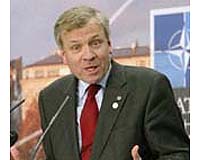
NATO Chief Lashes Allies Over Afghan Troop Commitments
Riga (AFP) Nov 28, 2006 NATO Secretary General Jaap de Hoop Scheffer hit out Tuesday at alliance countries for failing to provide reinforcements in insurgency-hit Afghanistan, as world leaders gathered for a summit in Latvia. In neighbouring Estonia, US President George W. Bush also urged his NATO counterparts to step up, saying they must "accept difficult assignments" like the increasingly fraught alliance mission in southern Afghanistan. NATO has been taken by surprise this year by a resurgent Taliban militia, ousted by a US-led coalition in 2001, whose rebellion has claimed some 3,700 lives, four times more than last year, according to an official report. "It is not acceptable that our mission in the south still lacks 20 percent of its requirements," Scheffer said ahead of the meeting, which starts with evening dinner talks on Afghanistan -- NATO's most ambitious operation. In September, NATO military commander US General James Jones called for some 2,500 extra military personnel for southern Afghanistan -- around 1,000 combat troops backed by about 1,500 logistical and other staff, plus equipment. But contributors have been slow to step forward. "When you have a situation where people are actually being shot at, you have combat operations, ... 10 or 15 percent becomes more important," Jones said Tuesday at a pre-summit conference in Riga. He said that shortfall could make all the difference in a tough battle. "You lose one or two infantry battalions, you lose helicopter mobility, you lose reconnaissance capability, you lose some of the critical enablers that you need," he said. Troop numbers aside, commanders on the ground are also frustrated by the caveats or conditions that nations are placing on the use of their forces. "Caveats take away operational effectiveness," Scheffer said. "We can ill afford reconstruction armies that cannot handle combat." British, Canadian and Dutch troops have borne the brunt of fighting in the south and east of Afghanistan, leading to calls on countries like Germany and Spain, posted in relatively peaceful regions, to become more involved. But the commanders are hamstrung by around 50 caveats, which range from geographical restrictions -- the biggest problem -- to refusal to fight at night or in winter conditions for lack of proper equipment. If the insurgency thrives, reconstruction will slow, and NATO fears ordinary Afghans will turn back to the Taliban militia, who have dramatically stepped up operations in recent months. "To succeed in Afghanistan, NATO allies must provide the forces NATO military commanders require," Bush said in Tallinn, Estonia on a stopover on his way to Riga. But security operations are only one part of rebuilding Afghanistan, where the NATO-led International Security Assistance Force (ISAF) is trying to spread the influence of President Hamid Karzai's weak central government. Scheffer also urged international bodies, like the European Union, the United Nations and the World Bank, as well as non-governmental organisations, to play a greater role. "We need a better international coordination structure for Afghanistan. We must provide the security and do the reconstruction, but we must also do the politics," he said at the German Marshall Fund hosted conference. He voiced support for a so-called "contact group" -- similar to the ones created for Bosnia and Kosovo -- to oversee reconstruction and development. "We need a body like the ... contact group in Kosovo that brings the key international actors together on a regular basis and coordinates overall strategy." French President Jacques Chirac first proposed the idea of a contact group, and he discussed it by phone on Monday with Bush as the US president was winging his way toward the Baltics, the French president's spokesman said.
Source: Agence France-Presse Community Email This Article Comment On This Article Related Links News From Across The Stans News From Across The Stans
 Pakistan Gets Approval For New Nuclear Plant
 Islamabad (AFP) Nov 25, 2006
The global atomic watchdog has approved an agreement with Pakistan for its second nuclear power plant, being built with Chinese assistance, the foreign ministry said Saturday. The 35-member Board of Governors of the International Atomic Energy Agency (IAEA) on Thursday unanimously approved the safeguards agreement for Pakistan's Chashma Nuclear Power Plant Unit-2, the ministry said in a statement. |
|
|

| The content herein, unless otherwise known to be public domain, are Copyright 1995-2006 - SpaceDaily.AFP and UPI Wire Stories are copyright Agence France-Presse and United Press International. ESA PortalReports are copyright European Space Agency. All NASA sourced material is public domain. Additionalcopyrights may apply in whole or part to other bona fide parties. Advertising does not imply endorsement,agreement or approval of any opinions, statements or information provided by SpaceDaily on any Web page published or hosted by SpaceDaily. Privacy Statement |